Somewhere between building and becoming.
This space holds the in-between moments, the growth, the doubt, the rebuilding, and the quiet wins no one sees. It’s an honest look at what it means to build a life that didn’t exist for women like me growing up.
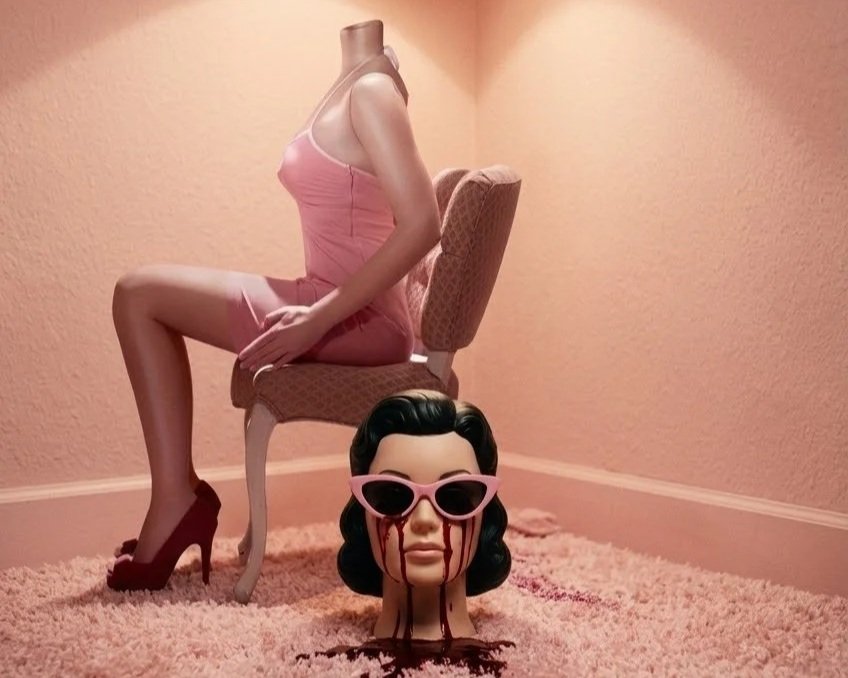
Everything Is Prettier in Pink
Some experiences refuse to be painted. The words come out the wrong color, or they come out too clean, scrubbed and pressed for company. I'll try anyway. One last attempt to show you what it is to be a woman in the twenty-first century.
You'll recognize the glasses when you see them.
You've seen them already. You might be wearing them now.
They arrive as a gift. Always a gift. Tissue paper, satin ribbon, a card in a grandmother's handwriting. The frames are a soft, flattering pink. The lenses shimmer like the inside of a seashell. Put them on and the world goes soft. Every sharp edge gets sanded into a curve. Every scream gets a soundtrack.
Through them, the world looks exactly the way it's supposed to. The good girl who never raises her voice. The bride being given away, glowing. The wife who is up first and asleep last and never, ever complains. The mother who has lost herself completely and calls it purpose. The woman who forgives, and forgives, and forgives, and looks so beautiful when she cries.
Through the glasses, all of it looks like a happy ending.
Nobody tells you what they actually are.
That they're alive.
They are a parasite. They root behind the eyes with thin pink threads and feed on the part of you that knows when something is wrong. In exchange, they give you the sweetest high there is. The feeling that it is all, somehow, love. They are a drug that makes the unbearable swallowable, one pastel spoonful at a time.
And like every drug, they have a dealer.
You'll recognize the dealers too. They look like family.
It's the aunty at the wedding who pinches your waist and asks when you're having a baby. The uncle who says boys will be boys. The teacher who says he only pulls your hair because he likes you. The stranger who tells you to smile. The fairy tale where she sleeps until he kisses her. The drama where she cries beautifully and forgives him by the final episode. The mother who got her pair from her mother, who got hers from hers, a long line of women passing down an heirloom that was only ever designed to keep them quiet.
But the dealers on the street never get rich. Follow the supply all the way up and you'll find rooms you've never been invited into. Rooms where people who will never wear the glasses decide how the rest of us should see. What we may wear. Who we may marry. What may happen inside our own bodies. Those rooms never have to raise their voice.
Why would they? We're already wearing the glasses.
I won't tell you who sits in those rooms. Count the chairs yourself.
The glasses are made for women. Fitted to our faces. Men are never handed a pair. Men don't need them. Men are what the lenses are protecting.
Women who have worn them long enough all describe the same symptoms. Tired eyes. A dull ache behind the brow. A stinging warmth that never quite goes away. We call it stress. Hormones. Not enough sleep. We take a Panadol and carry on.
Hold on to that.
So. Here is my life, in pink. And here is what was underneath it.
FIVE
They handed me my first pair when I was five.
Pretty things. I couldn't have cared less. I was on the floor with my hand-me-down action figures, the ones with chewed feet and missing thumbs, staging wars on the carpet. Good versus evil. Good always won. I loved the Power Rangers. They were so cool. They fought injustice in matching suits, and nobody ever told them to fucking smile.
For my birthday I asked for a Power Rangers cake. It arrived glossy and bright, five candles stabbed into the frosting. And it came with a gift. The glasses again, this time as words, tossed lightly over the candles like confetti.
"Girls shouldn't like Power Rangers."
Everybody laughed. The warm kind of laugh. The kind that means no harm and does it anyway. Someone pinched my cheek. Someone took a photo. In that photo I'm grinning with icing on my chin, and if you look closely there's a faint pink shimmer across my eyes. You'd think it was the flash.
The sentence flew right past me. All I cared about was that the cake had raisins in it.
Ew. Raisins.
A clueless five year old girl wouldn’t know that this is how it starts… Not with violence.
With frosting.
SEVEN
The shouting got worse that year.
It came through the walls. Doors slammed hard enough to rattle the picture frames. Something glass broke in the kitchen, and then came a silence that was worse than the breaking. I ran to my room with my hands clamped over my ears.
And there they were.
Waiting for me. Folded neatly in the lap of my teddy bear, like someone had tucked them in for the night.
I’m sure as hell I hadn't left them there.
I stared at them. They stared back.
My hand reached out slowly. As they came closer I could see the magic moving across the lenses, a soft glitter, swirling, like sugar dissolving in warm tea. They hummed. I swear they hummed. A lullaby pitched just for me. And they were warm. Not sun-warm. Body-warm. Like they'd been held in someone's palm for a very long time, waiting.
When they latched onto my face it felt like being held. Like curling up against Mama under the blanket. Like the very first embrace, when your cold, slippery body arrives on this earth screaming and someone decides you are theirs.
Then the world changed.
The shouting turned into music. A ballad, big and sweeping, strings and all. Through the gap in my door I watched my parents circle each other in the kitchen, and through the pink it looked like a dance. An arm raised. A body turning away. A waltz. The broken glass on the floor caught the light like sequins. My breathing slowed. My heart unclenched.
And the glasses whispered their first lesson into the soft folds of my brain.
Love requires a fight.
I never wanted to take them off. I loved the high. Felt like a Tove Lo song. For the first time I saw love everywhere. In the slammed doors. In the silence after. In the way my mother laid the table the next morning as if nothing had happened, setting each plate down so carefully, so quietly, like she was afraid it might scream. My mushy little brain understood something enormous. Even in the worst things, everyone is just looking for love.
Life through the lenses was magic. And the magic had rules. I learned them the way other kids learned their multiplication tables.
People who love you will hurt you.
Love requires sacrifice.
Love is compromise.
And the one who compromises is you.
I recited them in bed. I recited them in the bath. Some mornings I woke with my eyes stinging and faint pink rings around them, where the frames had pressed into me all night. Mama said it was allergies. I believed her. I think she believed it too.
As I grew, I started noticing other girls wearing them. In the playground. At family gatherings. Behind the counter at the provision shop. Some lenses were pale, barely a blush. Some were so pink you couldn't see the girl's eyes anymore, just two glossy discs where a person used to be. I wondered whether it affected their vision. Who was I to judge?
Funny thing, though. I never saw a man wearing them. Not my father. Not my uncles. Not the boys at school. Not the men at the head of every table. Not one.
What the fuck was that about?
NINE
I fell in love with a boy.
He sparkled extra in pink, like he'd been dusted in it. He fit the exact definition of what I'd learned love was. Troubled. Sad. Sulky. In need of empathy. In need of fixing. A broken thing. I would fix him. I'd glue every piece back together with my own patience, my own spit if I had to. And in return he'd save me, from the sadness of a world that only ever came in one stupid color.
That was the deal the glasses offered. A girl's whole job, at nine years old. Rehabilitation for badly raised boys.
Duh?
But the boys had a table, and I wasn't at it.
"You're too girly for us. Weak."
No I'm not!
I clawed at the glasses that afternoon in the school toilets, hard enough to leave red scratches down my cheeks. They wouldn't budge. They'd begun to melt into my skin, soft as warm wax, sealing at the temples, threading into my eyebrows. When I pulled, my skin pulled with them.
And something underneath pulled back.
Fine. I'd prove it another way.
I took up boys' sports. I scraped my knees and didn't cry. I mocked the girls who loved pink, the ones with hair clips and glitter pens, while wearing pink on my own face. I laughed when the boys called them stupid. All of it, just for a seat at the boys' table.
The table was sticky. It smelled like sweat and old lunch. Their jokes were lame. I laughed anyway, a little too loud, a little too long, like a laugh track in an empty studio.
And then, finally, he looked at me.
"You're different from other girls."
OH! The sweetness of it. It went down like syrup and coated everything. I was special. The exception. The cool girl. I had betrayed every girl I knew to be told I wasn't one of them. I won bitches.
The glasses never just blind you. They turn you into a weapon pointed at your own kind. They make you do the dirty work, so nobody ever has to see the hand behind it.
I was nine. So, what?
Soon enough, more girls caught on and wanted a seat too. Ugh.
Fine. I'll just have to be better.
At home, the arguments had started sounding better. Richer. The screaming felt like care. If they were yelling, they still cared. It was comforting, the way a familiar smell is comforting even when that smell is your own burning flesh.
TWELVE
The pink starts to rot.
There was a man who watched me while I showered. I'd feel it before I saw it. A change in the air. A gap in the door that hadn't been there a minute ago. A shadow on the tiles that didn't move when it should have. The glasses glowed and told me, gently, that he was looking out for me.
Then there were his hands. Hands that kept going where no one had invited them. And the glasses, warm, almost motherly, said: "He's just making sure your body is okay."
The lenses got pinker after that. Louder. Thick enough to hum against my cheekbones like a fridge in an empty house. I stopped feeling the water on my skin when I showered. Then, slowly, I stopped feeling a lot of things.
That was the year I first tasted it. Copper, at the back of my throat, on the mornings after. Like I'd fallen asleep sucking on a coin. I didn't know what it was. I brushed my teeth until my gums bled, and then at least the taste had a reason.
As a grown woman who reads the fine print, I understand now. That pink was a twelve-year-old's mind doing the only thing it could. When you can't leave the room, you paint over the stain so you can keep living in it. The glasses didn't feel evil. It had to lie because the truth would have killed the girl wearing them.
That's what makes them so hard to take off. They saved my life.
But at what cost? Was it a life worth living?
THIRTEEN
A boy promised to take care of me for life. He said it like a vow, the way men say things in films right before the music swells. He would be a good leader for our family one day. A protector. Wasn't that what I wanted? What every woman wants?
But a man, the glasses explained, needs to experience love differently. A man has needs. To be loved, I had to give myself.
Love requires sacrifice.
So I said yes.
I said yes while my whole body shook. My knees. My jaw. My hands. It trembled like it knew something I didn't, like it was trying to warn me in a language nobody had ever taught me to speak.
It hurt. It hurt so badly the glasses slipped down my nose, and for one second I saw the room the way it really was. No pink. No music. Plain, flat, ugly light. A ceiling with a water stain shaped like a hand. An older boy. And me, thirteen. So small.
I changed my mind.
No. I don't want to. Please stop.
He didn't look at my face. "You're already here," he said.
Three words. And he pushed the glasses back onto my face with them, like a man sliding a ring onto a finger.
No. Please. Please.
My tears ran under the lenses and washed them clear. Through the water I saw the truth, sharp and colourless and enormous. I screamed no.
He didn't stop.
I'm going to say this plainly, because for years I couldn't. For a long time I tried to convince myself of another version of this story. One where maybe, somehow, I'd implied a yes, and that was the end of the conversation. It wasn't. I said no. I said it out loud. I said it more than once. I screamed it.
What happened after that was rape.
Read that word. Don't soften it on my behalf. I already did that for far too long.
When it was over he got up and left. Cold. Like closing a door on an empty room.
I lay there and stared at the hand-shaped stain on the ceiling. The tears dried on my face, stiff and salty. And slowly, like water filling a footprint in the sand, the pink seeped back in. Warm as bathwater. Soft as a nursery. I didn't notice, then, that the bathwater had a faint metallic smell. That it was a little too warm. A little too thick.
You sacrificed yourself for love, the glasses cooed. You'll be rewarded.
The real horror was the comfort that came after. The way the drug knew exactly how much to give me, and exactly when.
It felt like hell. Love meant handing myself over again and again, a vending machine that never ran out. Love felt like a leash. Do this, or the whole school will know you're impure. Used. A woman with no value. That was his threat, and he used it like a key whenever he wanted back in. I did not feel like a person. I felt like a room he had the keys to.
The thing about purity is that it's a cage they build around girls and then blame us for living in.
Every time I cried, the tears thinned the lenses to a muted pink, a bruise-pink, the colour of a wound trying to heal. And I could almost see. Almost.
Eventually I stopped. I said no to him, and that time it held. The rumours ran through the corridors like dogs let off the leash, sniffing at me in every classroom, in the canteen, at the school gate. And still, underneath all of it, the glasses kept a little candle burning.
Someday there'll be a man. Man enough to accept you for who you are.
As if acceptance were something to be granted to me. As if I were the damaged thing, and some generous man would one day agree to overlook your sins. Like a ever forgiving god. God is he, right?
FIFTEEN
I found another sparkle. This time in dead eyes.
I should have seen it. The glasses made sure I didn't. Through the pink, those flat eyes looked deep. Brooding. Wounded. A boy who'd been hurt by the world and only needed one girl to love him enough. A song on the radio. A poster on a bedroom wall.
The love was more intense than anything before. Just like my parents'. No, worse. Shouting that never quite stopped. Yelling that left my ears ringing at night. He yanked my hair in public, at a bus stop, in front of strangers who looked away, and through the pink it felt like a kiss. Passion. Proof that he couldn't stand to lose me.
I came to hate my birthdays. Something always went wrong on them. Something always got thrown. But love is sacrifice. I knew the catechism by heart. I could recite it in my sleep, and some nights I did.
One night his hands found my neck.
I remember the sound first. Or the lack of it. The room went quiet the way the ocean goes quiet when you slip under. His thumbs pressed into the soft hollow of my throat, and my breath simply stopped arriving. I opened my mouth and nothing came. Not air. Not a scream. Nothing.
My hands flew up and clawed at his wrists. My legs kicked at nothing. My heartbeat climbed into my ears and pounded there like a fist on a door. Little red stars burst behind my eyes. Pop. Pop. Pop. Like fireworks at a party. Fuckin Katy Perry. The edges of the room went dark and grainy, like old film burning in a projector.
And the glasses fell.
They slid off my face and dropped, and I heard them hit the floor. A tiny, ridiculous sound. Plastic on tile.
And I saw him.
Not the wounded boy. Not the brooding poet. Not the project I was going to fix. I saw a face with nothing behind it. Dead eyes, flat as coins, staring down at me. The face of someone working a stubborn lid off a jar.
I was nothing to him. Not a girl. Not a girlfriend. Not a person. An object in the way of whatever feeling he needed to finish having.
That's what the pink had been hiding. Not a monster with fangs. Something worse actually. Indifference, with its hands around my throat.
The part that still wakes me some nights is… My life was spared on a whim.
I rolled onto my side and dragged air back into my body. It came in like broken glass. My throat burned. My eyes streamed. And through the blur I saw the glasses lying on the floor beside me.
Pink. Glittering. Patient.
There were small dark smears on the inside of the lenses. Wet. I told myself it was mascara.
What actually scared me?
I reached for them.
With shaking hands, still choking, I picked them up and put them back on. Myself. No one made me.
Because the truth was too big. I had nowhere else to go. A girl who has just seen her own death in a man's eyes needs something to tell her it was love, or she will not survive the night.
That's what the drug is for.
The next morning, through the pink, the bruises on my neck looked like a necklace. Plum and violet, strung all the way around. I wore my hair down to campus.
Nobody asked.
My little sister was the first real dent.
She was so small then. Gap-toothed. Sticky-fingered. Smelling of milk biscuits and baby powder. She climbed onto my lap one afternoon, reached up with her little hand and tried to grab the glasses off my face, the way kids grab anything shiny. She giggled. She wanted a turn.
I caught her wrist. Harder than I meant to.
I looked at her looking at them. Those wide, clean eyes. Not a speck of pink in them yet. And something in me went cold and very clear.
Not her. Never her.
The glasses stayed on me. But there was a crack in the lens now. A hairline fracture, running corner to corner. You'd barely notice it. But light gets in through those. Light always finds the fracture.
It went on like that, dimly, for a while. Until I became a mother myself.
MOTHER
Giving birth stripped me. Every part of it. Hours of it. It shed my body and my being the way a snake leaves its skin. I was raw. Torn open. Nothing between me and the world.
And then they placed my daughter on my chest.
The glasses simply melted. They dripped off my face like candle wax and were gone. I didn't decide to take them off. They just couldn't survive in the room with her.
I wanted to see her in full colour. All of her. Every bit she was. Her wet dark hair. The impossible tininess of her fingernails. The fury in her first cry. I didn't need the numbness. For the first time in my life, I didn't want it.
Then came confinement.
Weeks indoors, with soups and aunties and rules. Don't wash your hair. Don't go out. Don't drink anything cold. And the glasses came back, the way they always come back. Through words. Gift-wrapped.
You're a mother now.
You're a wife now.
Your life isn't yours anymore.
This is what women do.
Each one another tiny screw tightening the hinge. Each one said with love. That's what makes it so hard to fight. Almost nobody hands you the glasses out of cruelty. They hand them to you because someone handed them theirs, and they survived, and they think surviving is the same thing as being alive.
But on the days I was alone with my daughter, I'd pry the damn things off. Fingernails under the frames, wincing, peeling them away from the skin like a plaster off a wound. Just so I could have her as she really was. The creases in her wrists. Her milk-drunk sleep. The furious little face she made right before she cried.
Slowly, my vision adjusted. The way your eyes do in a dark room, shape by shape. I started seeing things for what they were.
In Technicolor.
And one morning, holding the glasses up to the window, I finally understood what the pink had been all along.
It was blood.
The pink rings around my eyes at seven. The copper on my tongue at twelve. The warm, thick bathwater at thirteen. The wet smears on the lenses at fifteen. It had been there the whole time. The blood bursting in my own eyes. Capillaries popping from years of holding in the rage. Holding it so tight, just so I could function. Just so I could smile at the table and pass as a person.
The rose tint was never magic. It was me, haemorrhaging quietly behind my own face.
I went to the mirror without them.
My face was disfigured. Like something out of a horror film, the kind where the girl in the nightgown turns around slowly and you wish she hadn't. Eyes hollow. Skin grey. The whites of my eyes webbed with red, like cracked porcelain. Dead.
I put the glasses back on, just to check.
And there she was. Perfectly tousled hair. Soft pink lips. Eyes with a delicate glint of sadness, like a heroine in a perfume advert. The perfect victim. The woman who gives. So generous. So patient. So pretty in her suffering. The ideal woman, exactly as advertised. Smiling through it all.
Off. The horror film.
On. The fairy tale.
Off.
On.
Off.
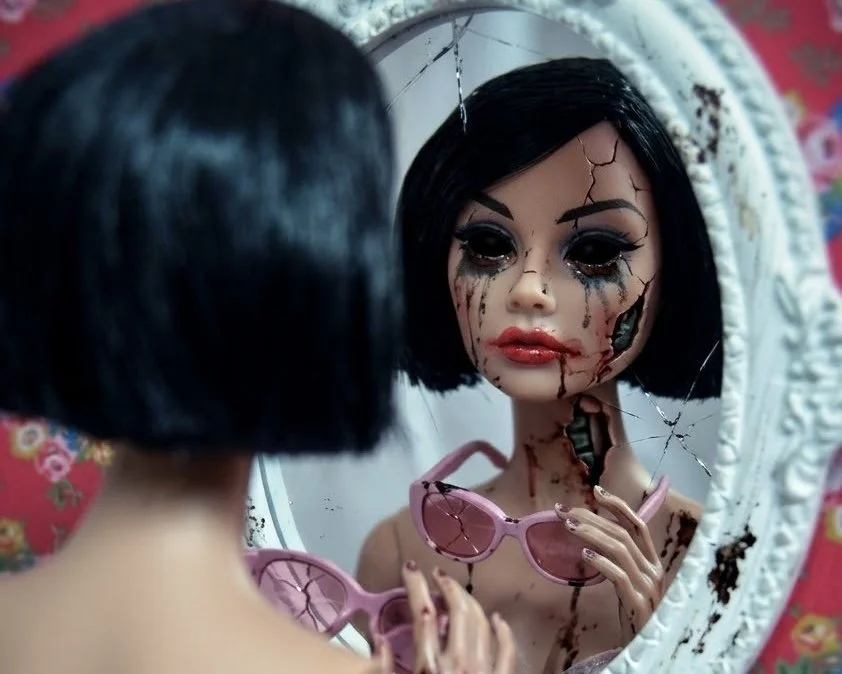
Is this how my daughter sees me?
I held her. With whatever love I thought I had left in me, which wasn't much. Just to feel it. The beauty and the honour of being trusted by her, completely, without conditions. A demon like me. A monster. An outcast.
How could something so beautiful come from me?
And something deep inside me moved.
Not healed. Not yet. Opened. Like finding a door in a house you've lived in your whole life, and behind it, a vast field with mountains in the distance. Uncharted. Full of light. Full of abundance. My love. My grace. Mine.
I looked in the mirror again. Without the glasses. And I honoured that demon. That hollow-eyed, grey-skinned, furious woman who had survived everything they did to her.
Then I moved on.
TWENTY-ONE
I found love again at twenty-one. I married again.
He is a good man. A genuinely good one. He listens. He learns. He tries. He picks up the list when I hand it to him, and more and more, he picks it up before I have to. If you're waiting for the villain in this chapter, there isn't one.
That's what makes it a horror story.
Because the glasses still found me. They always do. Muted pastels this time. No neon. No hands on my throat. Just a soft, steady, pretty pink.
I have not met a man without a hint of misogyny in him. I don't say that to be cruel. I say it the way you'd report the weather. It's in the water. It's in the air. They breathe it in from birth, the way we breathe in the glasses. Even the good ones. Especially the good ones, because nobody thinks to check.
Being a wife in a healthy heterosexual marriage felt like living in a glass box. A pretty house with walls made entirely of glass, so the whole world can see how happy we are. Observed, but not seen. Discovered, but never explored.
It's never the big things. It's the small ones, stacked like plates in a sink.
It's that the school calls me first. I'm mid-presentation, a dozen faces on the screen, and my phone lights up on the desk. The school. A fever. Can someone come? His number is right there on the form, second line. They call me. They always call me.
It's the colleague who asks, with a perfectly kind face, "So who's taking care of the kids today?" Nobody has ever asked him that. Not once.
It's "Oh, he's babysitting today?" Babysitting. His own children. In his own house. When a man does it, it's a favour. When a woman does it, it's just called being a mother.
Hell, its my first time being a parent too. Why does he look at me like some kind of manual for parenting?
It's the opportunities I quietly didn't put my hand up for, because the timing clashed with pickups. At first he didn't see it. Why would he? It had never cost him anything. When I finally laid it all out, every trip skipped, every late meeting declined, every door I'd let close without a sound, his face changed. And he adjusted. He really did. He moved his schedule. He took the calls. He became the one who leaves early.
And I was grateful.
Sit with that for a second. I was grateful. To a man for doing what I had been doing for years without anyone asking.
A good man cannot fix our broken world.
Some nights I tell him a story from the news. A woman assaulted on her way home. A girl blamed for what she was wearing. A wife killed by a husband who was "under a lot of pressure." My hands shake while I'm telling it. My chest goes hot. Somewhere behind my ribs, a thirteen-year-old girl is screaming no.
And he listens. He says, "That's terrible." He means it.
Then he picks up his phone.
He isn't cruel. He just isn't on fire. He can empathise, but he can't feel it in his body, because his body has never been the thing on the table. He has never walked to his car with his keys between his fingers. Never counted the exits. Never been told his scream was a yes.
He can stand next to the fire. He can't stand in it.
All while I’m still being consumed by the flames.
That's the distance. Even the best men live on the far side of it. And I'm on this side, alone, with the blood.
Then come the women.
”You're so lucky."
"He's such a good husband."
"I wish mine was like that."
They mean it kindly. They look at me with something close to envy. And I want to scream.
What the actual fuck?
Lucky? He listens. He learns. He parents his own children. He doesn't hurt me. That's not a fairy tale. That's the bare minimum. A good man is just an average woman. Everything women have always done, without applause, without anyone calling them lucky, done by a man, and suddenly it's a miracle.
The bar isn't low. It's buried. And we're all down there on our knees in the dirt, clapping for the men who manage to step over it.
That's what makes me so angry. Not him. The applause.
So the rage built. Quietly. Politely. Year after year. I swallowed it and folded it into the laundry. Ironed it into his shirts. Packed it into the lunchboxes. I never threw a plate. Never flipped a table. Never punched a wall.
Now flip it. Give a man the school calls. The babysitting comments. A career he has to negotiate for, one missed opportunity at a time. The news stories that feel like memories. Give him a single week of it. The neighbours would hear. Some door would slam hard enough to rattle the picture frames. And everyone would nod and say, well, he's under a lot of pressure.
I was under the same pressure. I just wasn't allowed to make a sound.
Picture perfect. Haemorrhaging. Smiling at the school gate with blood in my eyes.
Nobody photographs the woman who sits in her parked car for ten minutes, engine off, before she can walk into her own house.
What the fuck is this?
Are there levels to this shit?
So here's what I do now.
I don't give a fuck.
I have audacity. I chase what I want, out loud, without asking permission and without apologising for the timing. When an opportunity comes, I put my hand up first and sort out the logistics after, the way men always have. He's a parent too. He picks up. He figures it out. And you know what? He learns. He's good at it. He was always capable. He just never had to.
Me. Me. Me. I take up space now. All of it. My side of the bed. My seat at the table. My calendar. My career. My rage.
I am tired of the fucking sacrifices. I have been sacrificing since before I could spell the word. The blood in my body belongs to me. Not to him. Not to the family. Not to anyone's idea of a good woman. And the heart that pumps it will beat for my own purpose. I don't need to explain myself to anyone. Or shrink for anyone.
And then my son was born, and he ripped the glasses clean off.
Not melted this time. Torn. The frames snapped in two with a sound like a small bone breaking.
Because I looked at this tiny boy and understood that I was raising the other half of the machine. The half that never gets handed the glasses. The half the glasses were built to protect. And I looked at my daughter and refused, flatly and completely, to be the mother who makes excuses. Who hands her the glasses wrapped in tissue paper and satin ribbon and calls it love. Who teaches her to see life only through a romanticised, rose-tinted lie.
My son will learn what the glasses hide. My daughter will never have to wear them to survive.
That ends with me.
NOW
The life I lived before was borrowed. Augmented. Altered to serve whatever it served. A parasitic ideology, feeding quietly off its host while whispering that she's being cared for.
Now I have to find my own truth. Name the injustice, out loud, in full colour.
The memories come back raw. Unsoftened. Sometimes in the middle of a meeting. Sometimes while I'm brushing my daughter's hair. But at least now it's a clear fight. I can see what I'm fighting, and that is more than I could say for most of my life.
It was hard to admit.
I was not only a victim. For years I kept my own misery alive. I was the villain in my own story. Don't misunderstand me. There were vile people. Some of them did unforgivable things to a child, and that is on them. Never on her. Never on the little girl in the shower, the thirteen-year-old saying no, the fifteen-year-old on the floor.
But of everyone in this story, the one person you'd expect to be kind to you is yourself. And I just watched. A bystander in my own life. Holding the glasses steady on my own face. Picking them up off the floor and putting them back on.
I see people clearly now. Most of them are still wearing rose-coloured glasses. Women at the office. Women at weddings. Women in the comment sections, defending the men who hurt them. Girls in school uniforms who already know which jokes to laugh at. Sometimes all they need is a nudge.
So here is mine.
This is an addiction. Not a substance you can flush or a pill you can count. An ideology. And the high it sells is the oldest one there is… To be validated, to be seen, to be loved. The glasses don't take away the pain of living as a woman in a world like this. They just make it pretty enough to swallow. Pink frosting on a poisoned cake. A fairy tale built on a grave.
Every day, millions of women walk around inside a horror film and call it a romance. We’re told to dumb ourselves down because the alternative is to see what the pain has cost us.
We should be angrier. Much angrier. We are carrying the labour, the blood and the rage all at once, and we've been trained to carry all these with a smile. Rage isn't the problem. Rage is the alarm. It's the part of you the glasses were built to feed on, the part that still knows something is wrong. Stop smothering it. Let it ring.
And then turn the mirror around.
Because the glasses don't only get handed to us. We hand them down. Every time we tell a daughter to be patient with him. Every time we call a father a babysitter. Every time we tell a woman she's lucky for being treated like a person. Every time we laugh at the joke at the boys' table. Somebody else built the machine. But we keep it oiled.
Taking the glasses off once is not recovery. It's a temporary fix. They find their way back. Through a compliment. A title. A sermon. A fear. A man's sudden kindness after weeks of cruelty. A mother saying just be patient with him. You don't get free by ripping them off in one dramatic moment. You get free by choosing, deliberately, every single day, to leave them on the floor. The way anyone in recovery chooses. Again. And again. And again.
Better yet, burn them. Watch the pink blister and curl and turn black. And don't pass them down. Not to your daughter. Not to your son. Not to the little girl at the next table who's already learning which jokes to laugh at.
I'm supposed to end this gently now. Tie it up with a ribbon. Make it inspiring. Palatable. Pink.
I can't.
Something's wrong with my eyes.
The page keeps blurring. I keep wiping it and my fingers come away wet and red, and it's coming out now, all of it, the pink rings and the copper and the bathwater and the necklace and the school calls and the applause, the fucking APPLAUSE, all of it bursting out of the tiny vessels behind my eyes where I stored it so neatly, so politely, for so many years, so nobody would ever have to see
Look at what those glasses did to my vision.
A man's hands on a twelve-year-old were care. My no was a yes. Rape was sacrifice. Thumbs on my throat were passion. A bruise was a necklace. Screaming was music. And a good man doing the bare minimum was a miracle I should be grateful for. GRATEFUL.
I was never looking at love. I was looking through my own blood.
So no. I won't shrink. I won't soften this for you. This is me taking up space. Bleeding all over your nice clean page. Look at it. LOOK at it. Nobody looked up when I needed them to. You're going to look now.
It's on the floor. It's on the walls. It's on the wedding photos and the report cards and the meeting invites and the confinement soup. It doesn't stop. I don't want it to stop.
And it isn't pink anymore.
It's red. Not rose. Not blush. Not soft. RED. Passion red. Stop-sign, open-wound, labour-ward red. The red of every woman who ever bit her tongue until it bled and called it patience. The red they taught us to hide every month, wrapped in tissue, slipped into a bin like a secret. The red we split open with to bring every single one of them into this world.
Let it spill.
There is so much of it. There always was. Every woman you know is carrying litres of it behind her eyes, holding it in, smiling, passing the rice.
Imagine if we all let go at once.
It would flood the streets. It would seep under the doors of those rooms we were never invited into and soak through the carpets and the contracts and the sermons and the fairy tales and the comment sections. It would wash the pink off everything.
They told us our blood was dirty. It was never dirty. It's the oldest cleanser on earth. We bleed and we don't die. We bleed and we make life.
And we will cleanse this earth with it.
Breathe.
The bleeding slows. It always does, eventually. And what it leaves behind is a clean window.
What you were fighting for was never him. Never them. Never a seat at anyone's sticky table. The whole fight was always about finding your way back to yourself. Being able to lower the lenses, look in the mirror, and love every part of what's there. The hollow eyes. The rage. The blood. The grace. Including the parts you don't.
The love waiting on the other side has no tint.
It has depth. It comes in Technicolor.
It is abundant. Wide. Clear.
You don't have to wait for the birth of a child to tear them off. Like every addiction, it comes down to one question. One you have to answer alone, in front of the mirror, without the pink.
Not what are they doing to you.
What are you still doing for them?
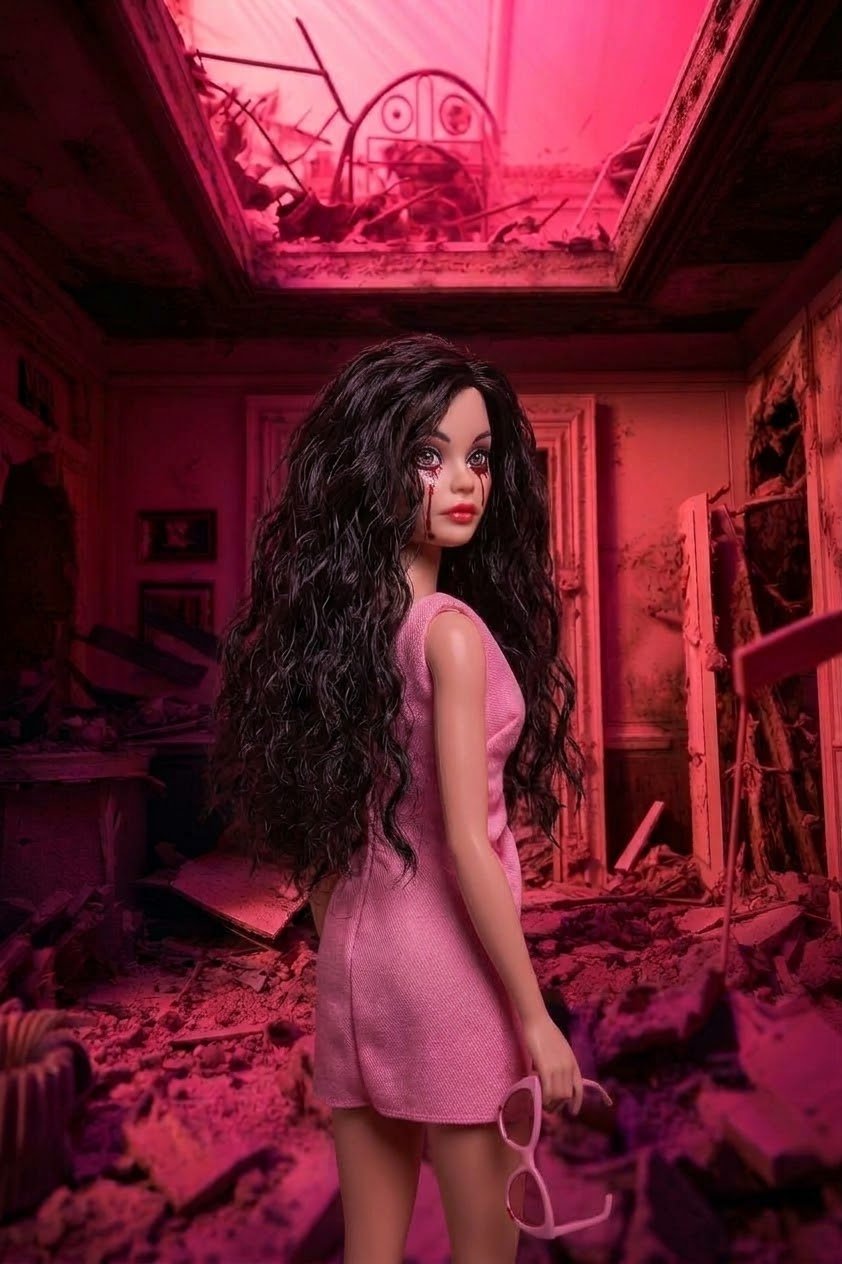
What are you refusing to accept?
The Universe Has a Funny Way of Making Sure You Commit the Sins You Mock.
We all know someone who has very firm opinions about what kind of person they would never become. You know this person. You might be this person. I am, at times, absolutely this person.
We do it quietly, the way you don't notice you're holding your breath until you already need air.
My mother swore she would never raise her voice the way her mother did. I watched her become her mother on an unassuming Wednesday, over something small, something I've since forgotten. She didn't notice. You rarely notice when you cross the line you drew.
We grow up watching the adults around us fail and we take notes. We write the first draft of who we'll be in contrast to who they were. We watch someone lose themselves to grief, to rage, to need, and we file it under weakness, a category we have very confidently excluded ourselves from.
And then life, with its impeccable comedic timing, takes notes right back.
"You don’t get to graduate from a lesson by spectating it. The universe doesn’t warn you. It just quietly builds the exact circumstances that will make you understand, from the inside, every person you ever looked down on. You just wake up one day already in the middle of the lesson."
I've watched people (brilliant, self-aware, genuinely good people) do the exact things they once publicly despised. The man who swore he'd never become his father comes home one Tuesday and hears his father's words in his own mouth, aimed at his own child. The woman who used to judge her colleagues for staying in bad situations stays in one for three years. The activist who wrote essays about empathy becomes, under enough pressure, unkind in very human, very ordinary ways.
We’re told empathy requires imagination until it requires experience. And most of us, if we are being precise and a little brutal about it, are working with imagination. We think we understand addiction because we've read about dopamine pathways. We think we understand grief because we've lost something. We think we understand what makes people cruel because we've seen cruelty.
Understanding a thing from the outside is not the same as knowing it from the inside. And the universe, in its great indifference and its equally great precision, seems to know the difference.
There is a girl I grew up with who stole. Small things, from the provision shop at the corner, slipping sweets into her pocket with a practiced calm that unsettled me. I thought she was reckless. I thought something was missing in her. Years later I found out her family hadn't been eating properly for months. The sweets were sometimes the only thing she put in her mouth before school. I had watched her survive and called it recklessness.
"What looks like a character flaw from the outside is sometimes just a person doing the only thing that made sense with what they had."
The most frightening cruelty is the kind dispensed by good people in the name of good values. The parent who cuts a child off to teach them responsibility and never considers that the lesson landing might be: you are alone in this world. The friend who delivers a truth without care for the wound it opens and calls the wound evidence that the truth needed saying. The person who decides someone has suffered enough of their patience, as though suffering runs on a schedule they get to manage.
These people sleep fine. Nobody is the villain in their own story. It’s a little unsettling.
The most evil person in the room isn’t your typical cartoon villain. The one who is genuinely, thoroughly convinced that what they are doing is right, or necessary, or the only option anyone reasonable would choose. The one who has built, brick by brick, an entire belief system of justification so internally consistent that they have become, to themselves, the protagonist of a morality tale.
This is most of us, at various temperatures.
The deeply religious person who preached loudly about sin finds themselves, quietly, committing it. And the most exquisite part, the part that makes the universe seem almost petty in its thoroughness, is that it is always the specific sin. The one they named. The one they performed the most disgust about at dinner tables and in group chats and in the careful curation of their public self.
It would be funny if it weren't so ruthlessly precise.
A child who grows up without enough becomes an adult who cannot stop accumulating, and we call it greed. A child crushed under too much pressure becomes an adult who cannot tolerate failure, and we call it arrogance. We name the wound wrong and then we judge the bleeding.
Every trait we find contemptible in another person has a genesis. Follow it back far enough and you find a child who was just trying to get through the day.
"Evil does not usually arrive in a dark coat announcing itself. It arrives warm, well-intentioned, holding something that looks almost exactly like care."
And this is where the coin analogy breaks down. We keep imagining good and evil as two sides with a clean edge, a face you flip to when the other is facing down. But there is no edge. No moment of crossing. There is just the same water, moving, taking different shapes depending on the vessel and the temperature and the hour. A Möbius strip, smooth and continuous, where if you walk long enough in one direction you find yourself on what you thought was the other side, without ever having felt yourself turn.
The mercy can arrive wearing the face of loss. The thing that destroys you opens you. The path paved in what looked like cruelty becomes, twenty years later, the only road that could have taken you there.
The strongest people I've known are the ones who fell apart and did not build the same walls back up. They came out with less certainty and more room. Room for the mess of other people. Room for contradiction. Room to say, quietly, without performance: I don't know what I would have done in your position. And mean it from the stomach, the way truth has to mean things to count.
That sentence requires something of you. It requires you to have been somewhere you didn't plan to be. To have wanted something you were ashamed of wanting. To have made a choice you cannot fully defend but also cannot fully regret. To have committed, in some small or shattering way, the exact sin you once pointed at in someone else.
The soul does not expand in comfort. It expands the way the lungs expand, under pressure, when there is no other option, when the only way to survive is to take in more than you thought you could hold.
In all the pain and brutality, I believe the universe is completing you.
Not because suffering is noble. Please, let's retire that particular romance. Suffering is not noble. It is often ugly and boring and repetitive and it smells bad and it makes people on the outside uncomfortable. But it is experiential. It writes things into you that reading cannot. It builds in you a particular quality of knowing that has texture. The kind you can give another person when they need it, not as advice, but as presence.
The soul is not a fixed thing with fixed contents. It is more like a territory. And certain territories can only be reached by walking. Not by studying the map. Not by talking to people who've been there. By walking. Through the part you swore you'd never walk through. Through the thing you used to judge from a safe and self-congratulatory distance.
And when you come out the other side, if you come out, because some people don't, some people set up camp in the shame and live there for decades. You find something strange waiting for you. Not wisdom, exactly. Not strength. Something quieter. A kind of spaciousness. The ability to hold more. To be surprised less by the darkness in other people because you have finally, properly, met it in yourself.
I am not saying do the harm. I am not saying invite the darkness over and call it soul work. I am saying something more uncomfortable than that:
You will not always get to choose.
Some things will happen to you. Some versions of yourself will emerge that you did not plan and would not have selected. You will look in the mirror during a season of your life and not entirely recognise the person looking back because you are more yourself than you've ever been willing to be. More complicated. More contradictory. More human, in all the ways human is not a compliment and also the only thing worth being.
And the people who get through it (not unscathed, nobody gets through unscathed, that's the premise) are not the people who stayed strong. They are the people who stopped confusing strength with imperviousness. Who let the experience enter them. Who sat in the discomfort of becoming someone they had not planned to become and did not immediately reach for the nearest narrative to make it mean something clean. They just sit with the mess.
"The most dangerous kind of self-knowledge is the kind you arrive at yourself, without invitation, in the middle of something you cannot control. That is the kind that stays."
There is a strange, dark peace on the other side of this.
It does not feel like peace at first. It feels like something has been taken from you that you didn't know you were holding. A certain cleanliness. A certain confidence in your own goodness. The comfortable clarity of knowing which side of the coin you're on.
But under that loss, if you sit with it long enough, if you resist the urge to rebuild the old belief of certainty, there is something else. A loosening. The faint but unmistakable sense that you no longer have to manage your image of yourself quite so relentlessly. That you can look at another person in their worst moment and not flinch, not advise, not quietly congratulate yourself for being different.
Because you know now. You know what it costs. You know how slowly and how quietly a person can become the thing they feared, and how that becoming is not the end of them. It is, in some terrible and necessary way, part of what makes them whole.
The loop closes. The coin has no sides. The saint and the sinner are in the same body, with one beating heart. And the kindest, wisest, most expansive human beings I have ever met are the ones who know this because they lived it, and stopped lying about what the living taught them.
In the mess and chaos, you arrive somewhere true. Where you can sit next to a person in their worst version of themselves and recognise it. Where you can look at the thing you once called evil and understand how someone got there.
"Perhaps the question is not whether something is good or evil. Perhaps the question is whether you are willing to be expanded by it - even when the expansion feels, from the inside, exactly like being torn”
That is, I think, the whole point.
The Room You Were Born Into
How social class shaped my career before I even knew there was a game being played.
How social class shaped my career before I even knew there was a game being played
I want to tell you about the room.
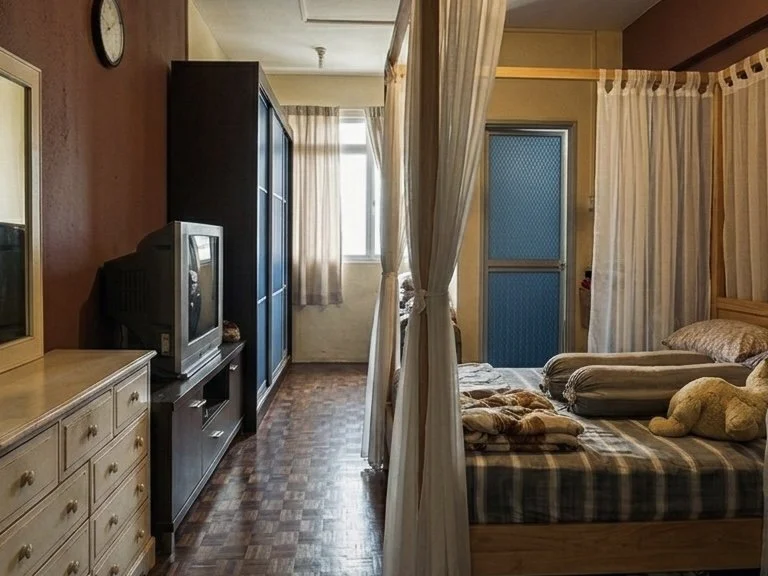
Not a metaphor yet. An actual room. One master bedroom in a flat in Pasir Ris that belonged to my mother's friend. Four of us lived in it. My mum, my stepdad, my younger brother, and me. I slept in the living room. We didn't have a house. We'd had a car once, and savings once, before a bad investment and a betrayal by people my parents had trusted completely dismantled the version of our life that might have been.
We were what people call sandwiched, not poor enough to qualify for help, not stable enough to feel safe. Low middle income, which in Singapore means you are exactly the wrong kind of struggling. You earn too much for the safety net and too little for the cushion. You exist in the gap and you are mostly invisible there.
My stepdad left for work before 5am. He was a prison officer. He had to do long shifts, heavy work, the kind of job that asks your body for things it doesn't give back. He'd come home around 8 or 9 at night, exhausted in a way I didn't have language for as a child, just a knowing. He ate. He rested. He got up and did it again.
He was the steadiest thing in a house that wasn't steady.
My mother is more complicated. She is still more complicated. I love her and I am still working out what it means to love someone who was often somewhere else even when she was standing right in front of you. She spent most of her nights out late, drinking, disappearing into a version of herself that had nothing to do with us. When things got bad enough, it wasn't just alcohol. We watched her fall, and then we watched her try to get up, and sometimes she did and sometimes she didn't and we were children and we absorbed all of it quietly because that is what children do.
There was love in my house. I want to say that. But love that is real and love that is stable are not always the same thing. I knew I was loved. But I was not always sure the ground would hold.
Now let me tell you about Sofia.
Sofia is not one person. She is everyone I have sat across a decision table from and tried to read like a manual. I studied the ease in her posture, the way she takes up space without apologizing for it, the way she speaks in meetings like she already knows she is allowed to be there. I have studied her the way you study a language you desperately need but were never taught.
Sofia's father was a director at a consulting firm. Sunday mornings in her house looked like this: a kitchen that smelled like coffee, a father mid-phone call, business language floating over breakfast like it was nothing. By the time she was ten, she had absorbed everything without anyone ever sitting her down to explain it. It came natural to her that authority was something you engaged with. Not something you endured.
When Sofia didn't want to finish her vegetables, she made her case. Her parents listened. Sometimes they conceded. She thought this was just family. She did not know she was being trained.
She visited her father's office before she had a word for what an office was. She shook hands with people whose names appeared on glass doors and buildings. She watched her parents walk into rooms and orient themselves without effort. Her nervous system absorbed the lesson before her mind did.
Nobody handed Sofia a manual. She grew up inside one.
Me? I grew up learning a different set of lessons. My childhood was a quiet, careful dance. I was learning how to be small so the house didn't feel so heavy. I was taught to wake up without a sound, solve the problem before it reaches a parent’s ears, handle the friction of life until your hands are calloused by it. When I didn’t finish my vegetables I was being wasteful. There is no room for negotiation. The only mentor I relied on was my survival instincts. I figured things out alone because everyone I loved was already running on empty.
The first time I walked into the office tower, the silence actually hurt. The air-con was so cold it felt expensive, and the marble floors were so polished they echoed the sharp, hollow sound of my cheap heels. I stood there, heart hammering, feeling like a glitch in the system. I didn't feel "success." I just saw a world that wasn't built for people like me. My body was coiled, waiting for a hand on my shoulder to tell me I was trespassing.
That is not nothing. As survival training, it is extraordinary. But it is not the same as being taught that the rooms you dream of are rooms you are allowed to walk into.
The thing I Didn’t Know I Was Missing
In 2003, a sociologist named Annette Lareau published research that changed how I understand my own childhood. She spent years sitting inside real families watching what parents actually did.
What she found was this: professional-class parents practised what she called concerted cultivation. They coached their children to question authority, negotiate with adults, advocate for themselves, engage with institutions as equals. Every dinner table, every disagreement, every after-school activity was quietly preparation for the rooms their children would one day need to occupy.
Working-class parents practiced natural growth. Children were loved and given freedom, but the lesson underneath everything was: respect authority. Stay out of trouble. Work hard and wait.
Neither is a wrong way to love your children. But only one of them is the native language of every gatekept institutions.
My stepdad gave me things that cannot be taught in any classroom. He showed me what it looks like to show up completely, every single day, regardless of what the day asks of you. To be the quiet constant when everything around you is noise. I carry that in how I work. In how I refuse to quit. In the part of me that gets up early and figures it out.
But Sofia's father was teaching her something else alongside the breakfast conversations. He was teaching her institutional fluency. The assumption, absorbed so early it became structural, that she belongs in rooms like this. That her voice has weight before she has proven it. She just gets to arrive.
I had to learn that feeling from scratch. As an adult. In real time. In front of people who were already watching.
“Employees from lower socio-economic backgrounds take 19% longer to progress through grades, a larger disparity than those linked to gender, ethnicity, or disability. This study, covering 16,500 staff, identified socio-economic background as the strongest barrier to career progression.”
When I first read that statistic, something in me exhaled. Because for a long time, I thought I was just slower. Less ready. Still catching up. I was taking a structural gap and wearing it as a personal failing.
It was the room I was born into.
The Rules Nobody Told Me
Let me be specific. Because I think specificity is where this stops being an essay and starts being useful.
Humility can work against you.
I was raised to be grateful for what I had and quiet about what I wanted. It was a survival skill rooted in my culture. In a home where the emotional weather could change without warning, making yourself small was often the safest option. Don't “show off”. Don't add to the noise. Let your work speak.
I carried that silence into every performance review, every pitch, every conversation with someone senior. When I won, I called it "luck." I thought I was being charming.I thought I was being easy to be around. I didn't realize that in their world, my modesty looked like a lack of ownership. My seniors just saw someone who didn't understand the magnitude of what she’d built.
The little girl sleeping in the living room learns to take up as little space as possible. But the woman building a legacy in these glass towers has to unlearn every inch of that training.
Today I say: "I built the strategy. It returned X%. Here's how."
I had to rewire my nervous system to accept that stating a fact is not the same as being arrogant. It is simply knowing your worth. You need that clarity especially in rooms where decisions are being made about your future while you aren't there to defend it.
The salary I didn't negotiate.
I accepted my first offer without a word. It felt generous. I was grateful. I didn't know that the number on the table was an opening position, not a final answer. I didn't know the person sitting across from me was genuinely expecting me to push back.
When you grow up in a house where money is anxiety and asking for more of anything feels dangerous, you do not negotiate. You accept. You are relieved. You say thank you.
Sofia countered. She had watched her father negotiate since she was old enough to follow a conversation. She knew it was part of the process. She asked for more. She got it.
That gap, the one opened by not knowing you are allowed to ask, does not close. It compounds. Quietly, across decades, into something enormous. And it starts with one conversation where you didn't know you had permission to speak.
Networking felt like begging in business casual.
For most of my early career, it did. Walking into a room full of people who had things and performing friendliness until they gave some of those things to you. In my world, you don't trouble people. You earn your own way. The whole practice felt, if I'm honest, a little shameful.
What I eventually understood is that framing was entirely wrong.
I was looking for people who could help each other grow. I had spent years building a career in the belly of these institutions, proving I could navigate their systems as a dedicated professional who outworked the room. But I realized that my value goes deeper than my output. It goes deep into my roots.
When I walk into a room as a Malay woman with deep, lived insight into communities that the people in that boardroom will never meaningfully reach, I take up space. I am bringing a professional record backed by a perspective that can’t be bought, taught, or faked. I don’t need to beg for a seat at their table. I am building a table of my own, a circle of collaborators for a mission they don’t yet realize they need.
That reframe changed everything. But I had to arrive at it alone, and late. After years of walking into the wrong rooms with the wrong story about why I was there.
An estimated 70 to 80% of jobs are filled before they are ever publicly listed — through referrals, informal conversations, and networks built over years of proximity.
I spent so much of my early career refreshing job portals and wondering why applications disappeared into silence. Sofia was having coffee with people who already knew her name. We were not playing the same game. I didn't even know there were two different games.
The Part That Lives In Your Chest
There is a specific exhaustion that comes from having built stability out of instability. From having made it into rooms your childhood gave you no map for, and then spending every moment in those rooms managing the distance between who you are and what the room expects.
I have sat at work dinners, my pulse steady but my mind doing frantic calculations. Which fork to use. How to hold an intelligent conversation about the market while secretly monitoring the grip on my wine glass. I’ve laughed at references I didn't understand because, in that world, asking feels like a confession. It feels like exposing a gap I was supposed to have filled years ago.
I have watched myself disappear in real-time. I’ve adjusted my voice without even deciding to, making it slightly slower, slightly more careful, scrubbing of the rhythm of home. I only realize I’ve done it on the bus back, sitting in the dark, replaying the evening and wondering whose voice was coming out of my mouth.
That is the part that lives in your chest. The constant, quiet labor of translating yourself so you don't get lost in the transition.
Code-switching. Researchers have a name for it. It is the energy you spend translating yourself into the language of the room before you have spent a single unit of it on the actual work.
While I was managing how I came across, Sofia was focused entirely on getting ahead. She didn't know there was a gap to manage. It had never occurred to her that she might need to translate herself.
And then you go home. And the gap is there too. Just reversed. You earn differently now. You move differently in certain rooms. You have grown in ways that are real and difficult to explain to people who knew you before all of this. You are not fully at work and not fully at home, and there is a loneliness in that in-between space that nobody warns you is coming.
Researchers call it class identity dissonance. I call it the tax of moving up.
“Nearly 60% of working adults in Singapore have experienced imposter feelings, particularly among younger professionals and women.”
In elite institutions, the friction of being working-class, Malay, and female is cumulative. It creates a redundancy of effort: where Sofia simply exists, I must architect my presence, managing a complex matrix of cultural codes and systemic filters just to reach the baseline of participation
I was not imagining it. I was not being weak. The data had a name for what I was carrying. And I had been picking it up every morning and calling it my own fault.
What I Know Now
I want to say something clearly before I go any further.
Sofia's advantage is not her fault. She didn't choose her dining table or her father's title or the ease with which rooms opened before she'd earned anything. Having privilege is not a character flaw. Not knowing it exists is.
And I am not a victim of my upbringing. My stepdad showed me what it looks like to be a person of complete integrity when the circumstances give you every reason not to be. My mother, complicated and human and still mine, taught me by contrast what I refused to become and that refusal shaped me as much as anything else. The chaos gave me a hunger for stability that has driven every good financial decision I have ever made. I built because I had seen what it cost not to.
The room I was born into was hard. It also made me.
But I do wish someone had handed me the map earlier. So here it is.
Your background is not your ceiling.
The room you were born into shaped your first language, your first understanding of what people like you are allowed to want. It is a starting point, not a sentence. The gap in your knowledge is not a gap in your worth.
Learn the language of the rooms you want to be in.
Not to lose yourself. But to become fluent enough to move through them without spending everything on translation. There are people who actually transcend class. You don’t need to perfectly imitate the people who are already there. You just have to learn the code well enough to hack it, and then show up so fully, so distinctly you, that the room has no choice but to make space.
Build the network before you're hungry for it.
Find the people two or three steps ahead of where you want to be. Be genuinely useful before you need anything. And find the other first-generation professionals in your field. The ones who also learned the rules by breaking them, who also know what it costs to be between worlds. They will not need you to explain yourself. They already know.
Be kinder to yourself about how long this takes.
You are learning the game while playing it. That is harder. It takes longer. The 19% is not a measure of your ability. It is a measure of your starting position. You are not behind. You are running a different race on a different track, without the training Sofia received before she even knew she was being trained.
Do not confuse where you started with how far you can go.
The Room We All Deserve
Today, I’m where I’m at. Not because I was exceptional, but because I was so afraid of the alternative. I knew what it felt like to have no ground under my feet, so I became tactical about building it. The chaos did that. My stepdad’s 5am shifts did that. Learning from my parents’ mistakes did that.
I still code-switch sometimes. I still feel the friction of entering rooms that weren’t built with me in mind, that slight sense of wearing clothes that almost fit but not quite. I still carry things I am only now learning to put down.
But I know something now that I didn’t know when I was a child making herself small in someone else’s house.
The barriers were real. They had names. I wasn’t imagining the gap or being dramatic or making excuses. I was navigating something genuinely hard with fewer tools than the person sitting next to me, inside a home that was not steady, and I did it anyway.
If you recognize yourself in this, if you have ever felt the weight of a gap you couldn't name.
I need you to hear this:
You are not behind. You are not less. You are not broken.
You are learning the map a little later than some people did. And that is okay. The map still works, even when you had to draw it yourself in the dark.
So reach back when you get further along. Do not just walk through the door; dismantle the lock. Be the strategic leverage you never had.
Because this was never just about the titles we negotiate or the rooms we finally occupy. It’s about the signal we send back to the ones still in the chaos. For the children perfecting the art of staying invisible. For the ones on living room floors, absorbing the silence, quietly deciding they will find another way.
They need to know the map exists. They need to know that ambition is not a transgression.
We were born into different rooms. We will not die in them. And we will leave the lights on for everyone coming after us.
SOURCES
1. The Sociological Framework
Lareau, A. (2003). Unequal childhoods: Class, race, and family life. University of California Press.
2. The Economic Data (The "Class Pay Gap")
KPMG, & The Bridge Group. (2022). Social mobility progression report: Mind the gap. https://socialmobilitycommission.gov.uk/wp-content/uploads/2022/12/Mind-the-gap-KPMG-Social-Mobility-Progression-Report.pdf
3. The Psychological Landscape (Singapore Context)
Well-Being Champions Network. (2023). Imposter syndrome in the Singapore workplace: Addressing the internal and external barriers to professional growth.
4. The Hidden Market Data
Fisher, J. F. (2019, December 27). How to get a job often comes down to one elite personal asset, and many people still don’t realize it. CNBC. https://www.cnbc.com/2019/12/27/how-to-get-a-job-often-comes-down-to-one-elite-personal-asset.html
5. The Cognitive Tax (HBR Research)
McCluney, C. L., Robotham, K., Lee, S., Smith, R., & Durkee, M. (2019, November 15). The costs of code-switching. Harvard Business Review. https://hbr.org/2019/11/the-costs-of-code-switching
If this hit you somewhere real , share it. Send it to someone who needed it. These conversations are how the map spreads.
I'm Syainda. My last piece about buying a home at 21 started a lot of conversations. This is where we keep going.