Somewhere between building and becoming.
This space holds the in-between moments, the growth, the doubt, the rebuilding, and the quiet wins no one sees. It’s an honest look at what it means to build a life that didn’t exist for women like me growing up.
The Parts I Survived
I was taught that silence was safety and endurance was love.
The Architecture of My Silence
The first thing I had to unlearn was that my silence was my safety.
I was a child when the script was handed to me. In my world, love was a transaction of self-erasure.
I was taught that
“Syurga di bawah tapak kaki suami — Heaven lies beneath the feet of your husband. ”
What a heavy thing to tell a little girl?
How can you look into her wide eyed gaze and tell her that her proximity to the Divine is measured by how much of herself she can bury to keep a man comfortable?
I grew up romanticizing the screams and mistaking volatility for depth.
At thirteen, the lights went out. I was violated and coerced by a boy who didn't know he was shattering a universe.
As I watched my innocence bleed out of me, I didn't reach for help. I reached for a mask.
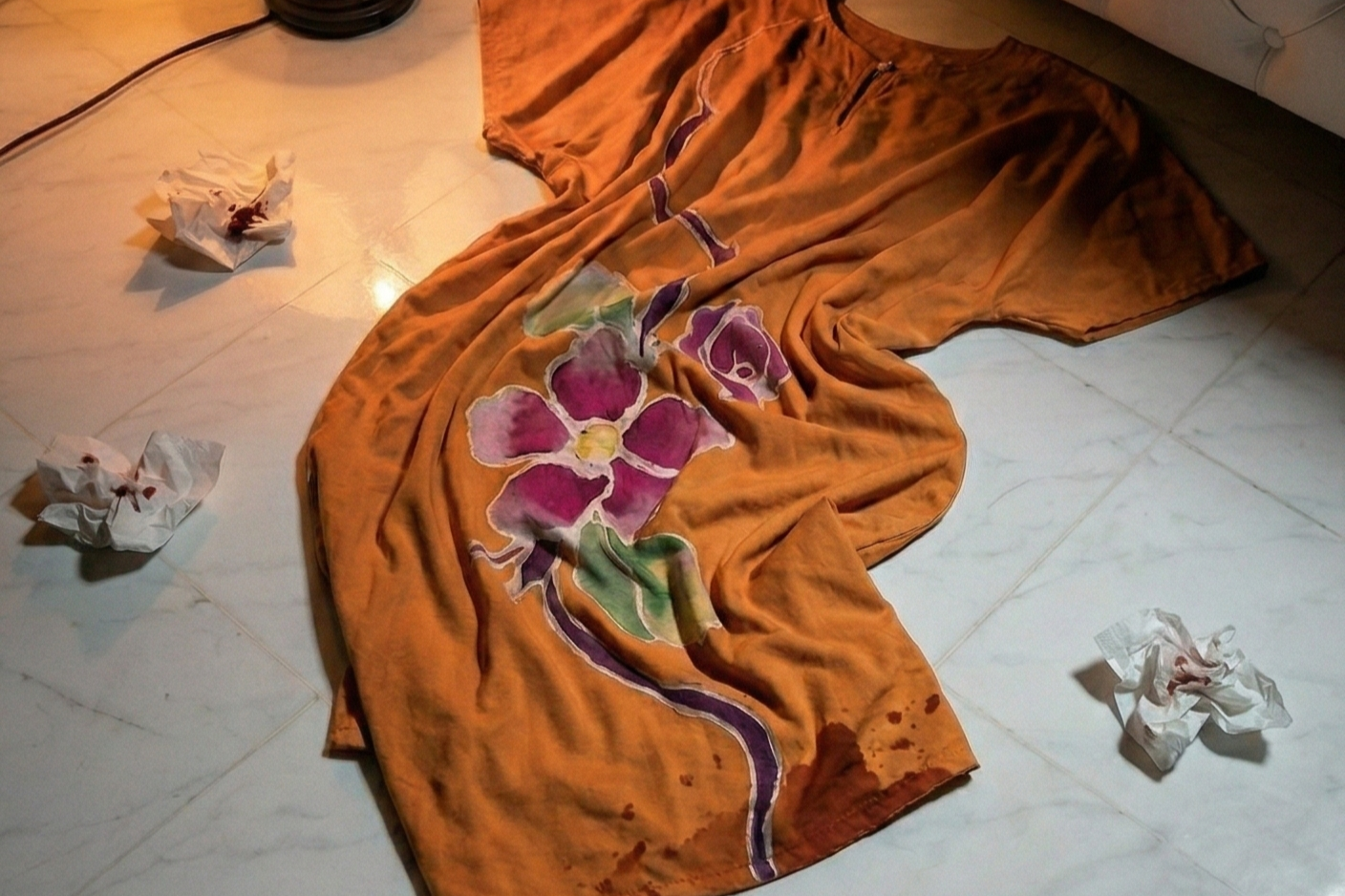
My first instinct wasn't to scream.
It was to apologize for the mess.
I believed I was "ruined," a broken thing that had to be the "perfect woman" for whoever would still have me.
I learned then that silence is the only currency the world accepts from a girl who has been stolen from.
The Great War: The Paradox of Growing Up Too Soon
At seventeen, society looked at me and saw a contradiction they didn't want to solve.
I was "old enough" to carry a life,
"old enough" to be a wife,
"old enough" to be bound to a man who treated my body like a conquered territory.
But according to the law, I was a child.
I was caught in the teeth of bureaucratic violence.
Too young to sign for a roof, too young to vote, too young to own my own name, yet I was expected to have the stoicism of a saint while breastfeeding in the dark.
The state told me to wait until I was twenty-one to be "legal," while the abuser I was forced to marry told me I was "trash from the streets."
There is a seething, quiet rage in being a mother who has to ask permission from her abuser and the system that perpetuate it to exist.
Society loves a "perfect victim". The one who stays quiet, looks pretty in the wreckage, and eventually disappears.
I refused to disappear.
The Blue Towel: A Glimpse of Mercy
Abuse is parasitic.
It feeds on your sanity until you are a hollowed-out version of yourself.
It does not arrive like a storm.
It arrives like damp in the walls.
Unseen at first.
Then everywhere.
It feeds slowly, until your mind no longer belongs to you.
It lives in sacred moments.
Three days after giving birth, when your body is still torn open from bringing life into the world, he betrays you.
Quietly.
Just enough to remind you that your pain does not matter.
As if fidelity were a luxury and my pain an inconvenience.
It lives in the theatre of despair.
“I’ll kill myself,” he said.
Not as confession.
As control.
A rope thrown around my throat, woven from guilt.
It lives in indignities so mundane they almost seem absurd.
It shows up in threats disguised as despair.
“I’ll kill myself,” he says.
Not because he wants to die, but because he knows it keeps you from leaving.
A leash made from guilt.
Then came the night the bathroom door was burst open.
It was the dull violence of something meant to protect giving way.
I remember the tiles against my feet.
Cold.
My skin still damp from the illusion of safety.
There is something profoundly animal about being cornered.
About knowing that there is nowhere to go.
“I’LL BASH YOUR F**KING HEAD IN.
I’ll F**KING K*LL YOU”
Numb.
My phone was at 1%.
My daughter was sleeping.
I prayed not for my life, but for her to stay asleep so she wouldn't witness me die at the hands of her own father.
That she would never know the sound a body makes when love becomes lethal.
The knock on the door was a fracture in the nightmare.
Ordinary.
Almost indecent in its normalcy.
Like a bell in a cathedral that has forgotten how to hold prayer.
A stranger.
A neighbor.
A WOMAN.
She walked past the man who had made me feel less than human…
and came straight to what was left of me.
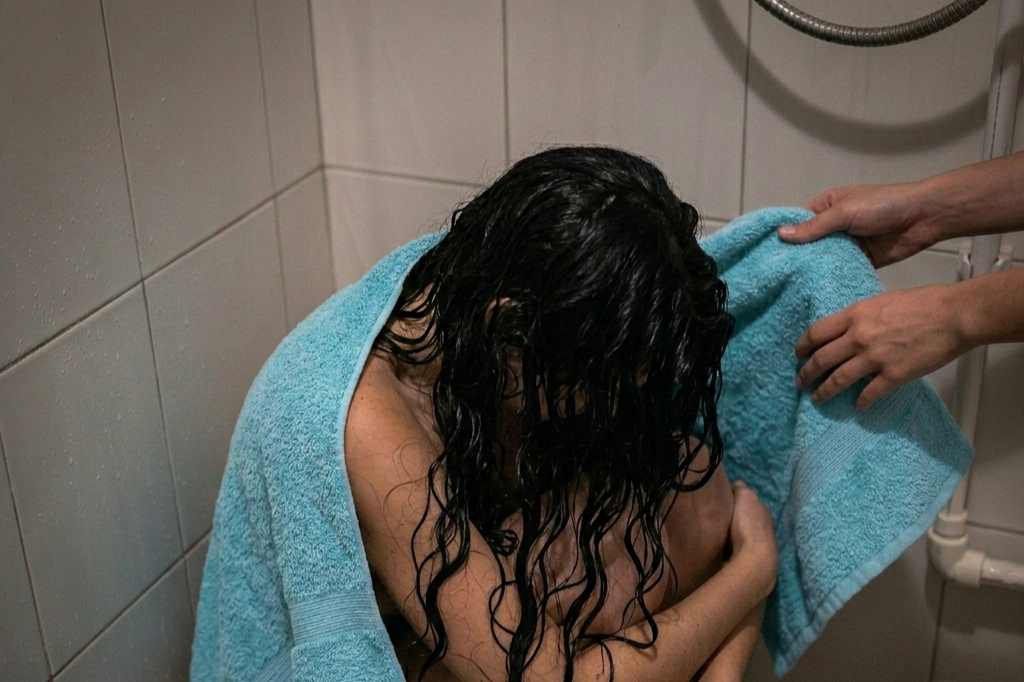
She handed me a blue towel.
I stayed in that piece of cloth for hours.
That towel was my first lesson in grace.
Not the grace bound in ritual or whispered in holy language, but the kind that comes freely, without claim or cost.
In that moment, something shifted.
The “heaven” I had been taught to find at a husband’s feet revealed itself for what it was.
A house already burning.
And for the first time, I understood that I was allowed to leave.
Playing Nice with Fire: The Strength in Darkness
When the housing officers told me I would be homeless if I left before I turned twenty-one, and the religious courts spoke of me as something that could be owned, something in me shifted.
I stopped waiting to be rescued.
I stopped believing the rules were built to protect me.
I learned to survive inside systems that had already decided my place.
I found a darker strength.
I created a version of myself that was ruthless, vengeful, and cold.
Society hates a woman who fights dirty.
But clean fights require fair ground.
And mine had already been taken.
So I learned to move quietly.
To smile when I needed to.
To comply when it bought me time.
To endure while I planned.
You gotta play nice with fire.
I seduced, I schemed, I stayed on the "good side" while I built a kingdom in secret.
I had to kill the "good girl" to save the "mother."
I became the villain in his story so I could be the architect of my daughter’s freedom.
I worked odd jobs until my hands shook.
As if survival had not already beaten me down, the sharpest betrayal came from women I thought would stand beside me.
They had heard my story. They had watched me hold everything together with shaking hands. They knew what it cost me to remain in school when exhaustion was constant and fear was knocking on my door everyday.
Still, they schemed to take my baby away. They reported me.
They called it concern.
They called it responsibility.
They said it was for the child.
The ultimate insult to a woman who was setting herself on fire to keep her child warm.
What they could not tolerate was the sight of a young mother refusing to disappear.
They questioned why I would not abandon my studies, as though ambition itself were negligence.
They saw a brief moment of normalcy, a simple family-friendly night out, and decided it was recklessness.
In their eyes, persistence became irresponsibility.
Effort became neglect.
Refusal to collapse became proof of failure.
Motherhood, for them, was meant to look like quiet surrender. I had to give up everything to be a good mother.
If I worked, I was absent.
If I studied, I was selfish.
If I sought a moment of ordinary life for my child, I was careless.
Every choice became evidence.
There is a particular humiliation in being judged by those who know how hard you are trying and choosing to believe it is still not enough.
Being kicked when you’re already down.
It felt as though they were waiting for me to collapse into the version of my life that made them comfortable.
A story where a woman like me does not strive.
Does not endure.
Does not dare to want more.
Waiting for me to become the cautionary story they had already written.
In refusing that story, I became something unsettling.
Not a victim to pity.
Not a mother to support.
But a woman who refused to break in the way they expected.
And sometimes, that is the most unforgivable thing of all.
The Reclamation: Holy Silence
The year I turned twenty-one, there was no celebration waiting for me on the other side of midnight, no gathering of light or laughter to mark the passage into adulthood. I have long moved past that version of myself.
I sat beneath fluorescent lights and signed the papers that would finally sever me from a marriage I had fought to escape, a marriage that had come too close to ending me.
The path to that moment had not been clean or safe. I had clawed my way through hearings and threats, through the slow grind of being told to wait, to endure, to stay.
And when I insisted on leaving, I came close enough to death to taste it in the air, to see it reflected in the rage in his eyes, a rage that made the future feel suddenly fragile.
It was dramatic.
Still, I stood.
Definitely not because I was fearless, but because there was nothin left for me to lose.
When the papers were signed, I had expected applause, some kind of triumphant chorus to mark the end of it all. Instead, I found only a quiet home.
Maybe this is what peace feels like.
I felt the weight of all that had been taken.
I paid the downpayment for a home that required no permission but my own, a place where my name alone was enough.
I walked through its doorway and closed the door behind me.
The silence that settled there was unlike any silence I had known before. It didn’t echo with footsteps I feared.
It was vast. Almost sacred.
And yet, instead of joy, I found myself grieving.
Grieving the girl who had learned too early how to survive.
Grieving the teenager who had mistaken endurance for love.
Grieving the woman who had hardened herself into something unrecognizable just to break through a system that saw her as less than human.
Freedom did not arrive loudly.
It arrived as an ache.
I was no longer seeking paradise beneath anyone’s feet.
I was standing on ground I had claimed with my own hands.
The sky above me was not given.
It was opened.
My life, for the first time, was my own.
I am free. The world did not give me justice, I took whatever I could to survive.
Even now, it falls short of justice.
And in doing so, I learned that
“Emancipation often begins not with happiness, but with grief.”