Everything Is Prettier in Pink
Some experiences refuse to be painted. The words come out the wrong color, or they come out too clean, scrubbed and pressed for company. I'll try anyway. One last attempt to show you what it is to be a woman in the twenty-first century.
You'll recognize the glasses when you see them.
You've seen them already. You might be wearing them now.
They arrive as a gift. Always a gift. Tissue paper, satin ribbon, a card in a grandmother's handwriting. The frames are a soft, flattering pink. The lenses shimmer like the inside of a seashell. Put them on and the world goes soft. Every sharp edge gets sanded into a curve. Every scream gets a soundtrack.
Through them, the world looks exactly the way it's supposed to. The good girl who never raises her voice. The bride being given away, glowing. The wife who is up first and asleep last and never, ever complains. The mother who has lost herself completely and calls it purpose. The woman who forgives, and forgives, and forgives, and looks so beautiful when she cries.
Through the glasses, all of it looks like a happy ending.
Nobody tells you what they actually are.
That they're alive.
They are a parasite. They root behind the eyes with thin pink threads and feed on the part of you that knows when something is wrong. In exchange, they give you the sweetest high there is. The feeling that it is all, somehow, love. They are a drug that makes the unbearable swallowable, one pastel spoonful at a time.
And like every drug, they have a dealer.
You'll recognize the dealers too. They look like family.
It's the aunty at the wedding who pinches your waist and asks when you're having a baby. The uncle who says boys will be boys. The teacher who says he only pulls your hair because he likes you. The stranger who tells you to smile. The fairy tale where she sleeps until he kisses her. The drama where she cries beautifully and forgives him by the final episode. The mother who got her pair from her mother, who got hers from hers, a long line of women passing down an heirloom that was only ever designed to keep them quiet.
But the dealers on the street never get rich. Follow the supply all the way up and you'll find rooms you've never been invited into. Rooms where people who will never wear the glasses decide how the rest of us should see. What we may wear. Who we may marry. What may happen inside our own bodies. Those rooms never have to raise their voice.
Why would they? We're already wearing the glasses.
I won't tell you who sits in those rooms. Count the chairs yourself.
The glasses are made for women. Fitted to our faces. Men are never handed a pair. Men don't need them. Men are what the lenses are protecting.
Women who have worn them long enough all describe the same symptoms. Tired eyes. A dull ache behind the brow. A stinging warmth that never quite goes away. We call it stress. Hormones. Not enough sleep. We take a Panadol and carry on.
Hold on to that.
So. Here is my life, in pink. And here is what was underneath it.
FIVE
They handed me my first pair when I was five.
Pretty things. I couldn't have cared less. I was on the floor with my hand-me-down action figures, the ones with chewed feet and missing thumbs, staging wars on the carpet. Good versus evil. Good always won. I loved the Power Rangers. They were so cool. They fought injustice in matching suits, and nobody ever told them to fucking smile.
For my birthday I asked for a Power Rangers cake. It arrived glossy and bright, five candles stabbed into the frosting. And it came with a gift. The glasses again, this time as words, tossed lightly over the candles like confetti.
"Girls shouldn't like Power Rangers."
Everybody laughed. The warm kind of laugh. The kind that means no harm and does it anyway. Someone pinched my cheek. Someone took a photo. In that photo I'm grinning with icing on my chin, and if you look closely there's a faint pink shimmer across my eyes. You'd think it was the flash.
The sentence flew right past me. All I cared about was that the cake had raisins in it.
Ew. Raisins.
A clueless five year old girl wouldn’t know that this is how it starts… Not with violence.
With frosting.
SEVEN
The shouting got worse that year.
It came through the walls. Doors slammed hard enough to rattle the picture frames. Something glass broke in the kitchen, and then came a silence that was worse than the breaking. I ran to my room with my hands clamped over my ears.
And there they were.
Waiting for me. Folded neatly in the lap of my teddy bear, like someone had tucked them in for the night.
I’m sure as hell I hadn't left them there.
I stared at them. They stared back.
My hand reached out slowly. As they came closer I could see the magic moving across the lenses, a soft glitter, swirling, like sugar dissolving in warm tea. They hummed. I swear they hummed. A lullaby pitched just for me. And they were warm. Not sun-warm. Body-warm. Like they'd been held in someone's palm for a very long time, waiting.
When they latched onto my face it felt like being held. Like curling up against Mama under the blanket. Like the very first embrace, when your cold, slippery body arrives on this earth screaming and someone decides you are theirs.
Then the world changed.
The shouting turned into music. A ballad, big and sweeping, strings and all. Through the gap in my door I watched my parents circle each other in the kitchen, and through the pink it looked like a dance. An arm raised. A body turning away. A waltz. The broken glass on the floor caught the light like sequins. My breathing slowed. My heart unclenched.
And the glasses whispered their first lesson into the soft folds of my brain.
Love requires a fight.
I never wanted to take them off. I loved the high. Felt like a Tove Lo song. For the first time I saw love everywhere. In the slammed doors. In the silence after. In the way my mother laid the table the next morning as if nothing had happened, setting each plate down so carefully, so quietly, like she was afraid it might scream. My mushy little brain understood something enormous. Even in the worst things, everyone is just looking for love.
Life through the lenses was magic. And the magic had rules. I learned them the way other kids learned their multiplication tables.
People who love you will hurt you.
Love requires sacrifice.
Love is compromise.
And the one who compromises is you.
I recited them in bed. I recited them in the bath. Some mornings I woke with my eyes stinging and faint pink rings around them, where the frames had pressed into me all night. Mama said it was allergies. I believed her. I think she believed it too.
As I grew, I started noticing other girls wearing them. In the playground. At family gatherings. Behind the counter at the provision shop. Some lenses were pale, barely a blush. Some were so pink you couldn't see the girl's eyes anymore, just two glossy discs where a person used to be. I wondered whether it affected their vision. Who was I to judge?
Funny thing, though. I never saw a man wearing them. Not my father. Not my uncles. Not the boys at school. Not the men at the head of every table. Not one.
What the fuck was that about?
NINE
I fell in love with a boy.
He sparkled extra in pink, like he'd been dusted in it. He fit the exact definition of what I'd learned love was. Troubled. Sad. Sulky. In need of empathy. In need of fixing. A broken thing. I would fix him. I'd glue every piece back together with my own patience, my own spit if I had to. And in return he'd save me, from the sadness of a world that only ever came in one stupid color.
That was the deal the glasses offered. A girl's whole job, at nine years old. Rehabilitation for badly raised boys.
Duh?
But the boys had a table, and I wasn't at it.
"You're too girly for us. Weak."
No I'm not!
I clawed at the glasses that afternoon in the school toilets, hard enough to leave red scratches down my cheeks. They wouldn't budge. They'd begun to melt into my skin, soft as warm wax, sealing at the temples, threading into my eyebrows. When I pulled, my skin pulled with them.
And something underneath pulled back.
Fine. I'd prove it another way.
I took up boys' sports. I scraped my knees and didn't cry. I mocked the girls who loved pink, the ones with hair clips and glitter pens, while wearing pink on my own face. I laughed when the boys called them stupid. All of it, just for a seat at the boys' table.
The table was sticky. It smelled like sweat and old lunch. Their jokes were lame. I laughed anyway, a little too loud, a little too long, like a laugh track in an empty studio.
And then, finally, he looked at me.
"You're different from other girls."
OH! The sweetness of it. It went down like syrup and coated everything. I was special. The exception. The cool girl. I had betrayed every girl I knew to be told I wasn't one of them. I won bitches.
The glasses never just blind you. They turn you into a weapon pointed at your own kind. They make you do the dirty work, so nobody ever has to see the hand behind it.
I was nine. So, what?
Soon enough, more girls caught on and wanted a seat too. Ugh.
Fine. I'll just have to be better.
At home, the arguments had started sounding better. Richer. The screaming felt like care. If they were yelling, they still cared. It was comforting, the way a familiar smell is comforting even when that smell is your own burning flesh.
TWELVE
The pink starts to rot.
There was a man who watched me while I showered. I'd feel it before I saw it. A change in the air. A gap in the door that hadn't been there a minute ago. A shadow on the tiles that didn't move when it should have. The glasses glowed and told me, gently, that he was looking out for me.
Then there were his hands. Hands that kept going where no one had invited them. And the glasses, warm, almost motherly, said: "He's just making sure your body is okay."
The lenses got pinker after that. Louder. Thick enough to hum against my cheekbones like a fridge in an empty house. I stopped feeling the water on my skin when I showered. Then, slowly, I stopped feeling a lot of things.
That was the year I first tasted it. Copper, at the back of my throat, on the mornings after. Like I'd fallen asleep sucking on a coin. I didn't know what it was. I brushed my teeth until my gums bled, and then at least the taste had a reason.
As a grown woman who reads the fine print, I understand now. That pink was a twelve-year-old's mind doing the only thing it could. When you can't leave the room, you paint over the stain so you can keep living in it. The glasses didn't feel evil. It had to lie because the truth would have killed the girl wearing them.
That's what makes them so hard to take off. They saved my life.
But at what cost? Was it a life worth living?
THIRTEEN
A boy promised to take care of me for life. He said it like a vow, the way men say things in films right before the music swells. He would be a good leader for our family one day. A protector. Wasn't that what I wanted? What every woman wants?
But a man, the glasses explained, needs to experience love differently. A man has needs. To be loved, I had to give myself.
Love requires sacrifice.
So I said yes.
I said yes while my whole body shook. My knees. My jaw. My hands. It trembled like it knew something I didn't, like it was trying to warn me in a language nobody had ever taught me to speak.
It hurt. It hurt so badly the glasses slipped down my nose, and for one second I saw the room the way it really was. No pink. No music. Plain, flat, ugly light. A ceiling with a water stain shaped like a hand. An older boy. And me, thirteen. So small.
I changed my mind.
No. I don't want to. Please stop.
He didn't look at my face. "You're already here," he said.
Three words. And he pushed the glasses back onto my face with them, like a man sliding a ring onto a finger.
No. Please. Please.
My tears ran under the lenses and washed them clear. Through the water I saw the truth, sharp and colourless and enormous. I screamed no.
He didn't stop.
I'm going to say this plainly, because for years I couldn't. For a long time I tried to convince myself of another version of this story. One where maybe, somehow, I'd implied a yes, and that was the end of the conversation. It wasn't. I said no. I said it out loud. I said it more than once. I screamed it.
What happened after that was rape.
Read that word. Don't soften it on my behalf. I already did that for far too long.
When it was over he got up and left. Cold. Like closing a door on an empty room.
I lay there and stared at the hand-shaped stain on the ceiling. The tears dried on my face, stiff and salty. And slowly, like water filling a footprint in the sand, the pink seeped back in. Warm as bathwater. Soft as a nursery. I didn't notice, then, that the bathwater had a faint metallic smell. That it was a little too warm. A little too thick.
You sacrificed yourself for love, the glasses cooed. You'll be rewarded.
The real horror was the comfort that came after. The way the drug knew exactly how much to give me, and exactly when.
It felt like hell. Love meant handing myself over again and again, a vending machine that never ran out. Love felt like a leash. Do this, or the whole school will know you're impure. Used. A woman with no value. That was his threat, and he used it like a key whenever he wanted back in. I did not feel like a person. I felt like a room he had the keys to.
The thing about purity is that it's a cage they build around girls and then blame us for living in.
Every time I cried, the tears thinned the lenses to a muted pink, a bruise-pink, the colour of a wound trying to heal. And I could almost see. Almost.
Eventually I stopped. I said no to him, and that time it held. The rumours ran through the corridors like dogs let off the leash, sniffing at me in every classroom, in the canteen, at the school gate. And still, underneath all of it, the glasses kept a little candle burning.
Someday there'll be a man. Man enough to accept you for who you are.
As if acceptance were something to be granted to me. As if I were the damaged thing, and some generous man would one day agree to overlook your sins. Like a ever forgiving god. God is he, right?
FIFTEEN
I found another sparkle. This time in dead eyes.
I should have seen it. The glasses made sure I didn't. Through the pink, those flat eyes looked deep. Brooding. Wounded. A boy who'd been hurt by the world and only needed one girl to love him enough. A song on the radio. A poster on a bedroom wall.
The love was more intense than anything before. Just like my parents'. No, worse. Shouting that never quite stopped. Yelling that left my ears ringing at night. He yanked my hair in public, at a bus stop, in front of strangers who looked away, and through the pink it felt like a kiss. Passion. Proof that he couldn't stand to lose me.
I came to hate my birthdays. Something always went wrong on them. Something always got thrown. But love is sacrifice. I knew the catechism by heart. I could recite it in my sleep, and some nights I did.
One night his hands found my neck.
I remember the sound first. Or the lack of it. The room went quiet the way the ocean goes quiet when you slip under. His thumbs pressed into the soft hollow of my throat, and my breath simply stopped arriving. I opened my mouth and nothing came. Not air. Not a scream. Nothing.
My hands flew up and clawed at his wrists. My legs kicked at nothing. My heartbeat climbed into my ears and pounded there like a fist on a door. Little red stars burst behind my eyes. Pop. Pop. Pop. Like fireworks at a party. Fuckin Katy Perry. The edges of the room went dark and grainy, like old film burning in a projector.
And the glasses fell.
They slid off my face and dropped, and I heard them hit the floor. A tiny, ridiculous sound. Plastic on tile.
And I saw him.
Not the wounded boy. Not the brooding poet. Not the project I was going to fix. I saw a face with nothing behind it. Dead eyes, flat as coins, staring down at me. The face of someone working a stubborn lid off a jar.
I was nothing to him. Not a girl. Not a girlfriend. Not a person. An object in the way of whatever feeling he needed to finish having.
That's what the pink had been hiding. Not a monster with fangs. Something worse actually. Indifference, with its hands around my throat.
The part that still wakes me some nights is… My life was spared on a whim.
I rolled onto my side and dragged air back into my body. It came in like broken glass. My throat burned. My eyes streamed. And through the blur I saw the glasses lying on the floor beside me.
Pink. Glittering. Patient.
There were small dark smears on the inside of the lenses. Wet. I told myself it was mascara.
What actually scared me?
I reached for them.
With shaking hands, still choking, I picked them up and put them back on. Myself. No one made me.
Because the truth was too big. I had nowhere else to go. A girl who has just seen her own death in a man's eyes needs something to tell her it was love, or she will not survive the night.
That's what the drug is for.
The next morning, through the pink, the bruises on my neck looked like a necklace. Plum and violet, strung all the way around. I wore my hair down to campus.
Nobody asked.
My little sister was the first real dent.
She was so small then. Gap-toothed. Sticky-fingered. Smelling of milk biscuits and baby powder. She climbed onto my lap one afternoon, reached up with her little hand and tried to grab the glasses off my face, the way kids grab anything shiny. She giggled. She wanted a turn.
I caught her wrist. Harder than I meant to.
I looked at her looking at them. Those wide, clean eyes. Not a speck of pink in them yet. And something in me went cold and very clear.
Not her. Never her.
The glasses stayed on me. But there was a crack in the lens now. A hairline fracture, running corner to corner. You'd barely notice it. But light gets in through those. Light always finds the fracture.
It went on like that, dimly, for a while. Until I became a mother myself.
MOTHER
Giving birth stripped me. Every part of it. Hours of it. It shed my body and my being the way a snake leaves its skin. I was raw. Torn open. Nothing between me and the world.
And then they placed my daughter on my chest.
The glasses simply melted. They dripped off my face like candle wax and were gone. I didn't decide to take them off. They just couldn't survive in the room with her.
I wanted to see her in full colour. All of her. Every bit she was. Her wet dark hair. The impossible tininess of her fingernails. The fury in her first cry. I didn't need the numbness. For the first time in my life, I didn't want it.
Then came confinement.
Weeks indoors, with soups and aunties and rules. Don't wash your hair. Don't go out. Don't drink anything cold. And the glasses came back, the way they always come back. Through words. Gift-wrapped.
You're a mother now.
You're a wife now.
Your life isn't yours anymore.
This is what women do.
Each one another tiny screw tightening the hinge. Each one said with love. That's what makes it so hard to fight. Almost nobody hands you the glasses out of cruelty. They hand them to you because someone handed them theirs, and they survived, and they think surviving is the same thing as being alive.
But on the days I was alone with my daughter, I'd pry the damn things off. Fingernails under the frames, wincing, peeling them away from the skin like a plaster off a wound. Just so I could have her as she really was. The creases in her wrists. Her milk-drunk sleep. The furious little face she made right before she cried.
Slowly, my vision adjusted. The way your eyes do in a dark room, shape by shape. I started seeing things for what they were.
In Technicolor.
And one morning, holding the glasses up to the window, I finally understood what the pink had been all along.
It was blood.
The pink rings around my eyes at seven. The copper on my tongue at twelve. The warm, thick bathwater at thirteen. The wet smears on the lenses at fifteen. It had been there the whole time. The blood bursting in my own eyes. Capillaries popping from years of holding in the rage. Holding it so tight, just so I could function. Just so I could smile at the table and pass as a person.
The rose tint was never magic. It was me, haemorrhaging quietly behind my own face.
I went to the mirror without them.
My face was disfigured. Like something out of a horror film, the kind where the girl in the nightgown turns around slowly and you wish she hadn't. Eyes hollow. Skin grey. The whites of my eyes webbed with red, like cracked porcelain. Dead.
I put the glasses back on, just to check.
And there she was. Perfectly tousled hair. Soft pink lips. Eyes with a delicate glint of sadness, like a heroine in a perfume advert. The perfect victim. The woman who gives. So generous. So patient. So pretty in her suffering. The ideal woman, exactly as advertised. Smiling through it all.
Off. The horror film.
On. The fairy tale.
Off.
On.
Off.
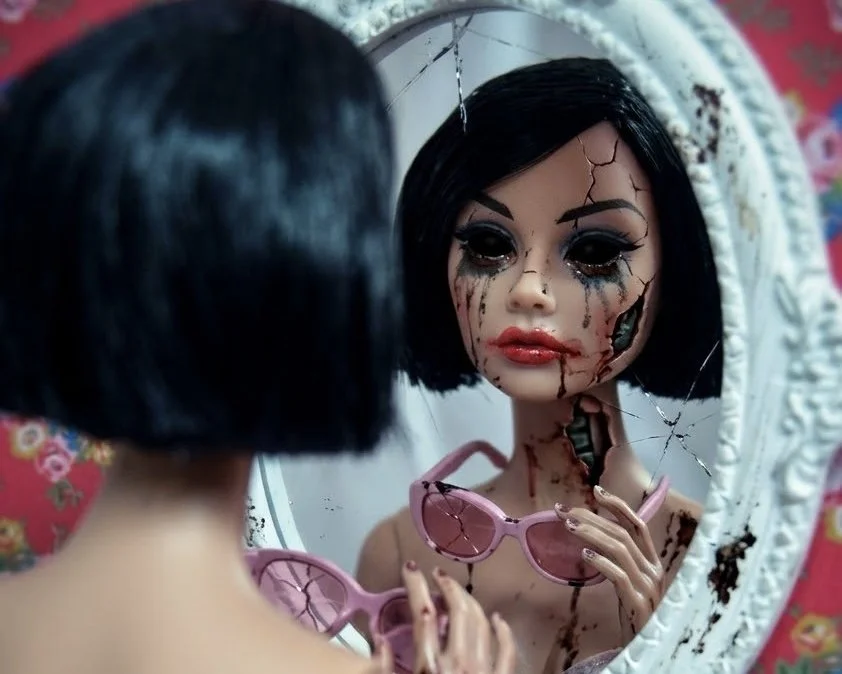
Is this how my daughter sees me?
I held her. With whatever love I thought I had left in me, which wasn't much. Just to feel it. The beauty and the honour of being trusted by her, completely, without conditions. A demon like me. A monster. An outcast.
How could something so beautiful come from me?
And something deep inside me moved.
Not healed. Not yet. Opened. Like finding a door in a house you've lived in your whole life, and behind it, a vast field with mountains in the distance. Uncharted. Full of light. Full of abundance. My love. My grace. Mine.
I looked in the mirror again. Without the glasses. And I honoured that demon. That hollow-eyed, grey-skinned, furious woman who had survived everything they did to her.
Then I moved on.
TWENTY-ONE
I found love again at twenty-one. I married again.
He is a good man. A genuinely good one. He listens. He learns. He tries. He picks up the list when I hand it to him, and more and more, he picks it up before I have to. If you're waiting for the villain in this chapter, there isn't one.
That's what makes it a horror story.
Because the glasses still found me. They always do. Muted pastels this time. No neon. No hands on my throat. Just a soft, steady, pretty pink.
I have not met a man without a hint of misogyny in him. I don't say that to be cruel. I say it the way you'd report the weather. It's in the water. It's in the air. They breathe it in from birth, the way we breathe in the glasses. Even the good ones. Especially the good ones, because nobody thinks to check.
Being a wife in a healthy heterosexual marriage felt like living in a glass box. A pretty house with walls made entirely of glass, so the whole world can see how happy we are. Observed, but not seen. Discovered, but never explored.
It's never the big things. It's the small ones, stacked like plates in a sink.
It's that the school calls me first. I'm mid-presentation, a dozen faces on the screen, and my phone lights up on the desk. The school. A fever. Can someone come? His number is right there on the form, second line. They call me. They always call me.
It's the colleague who asks, with a perfectly kind face, "So who's taking care of the kids today?" Nobody has ever asked him that. Not once.
It's "Oh, he's babysitting today?" Babysitting. His own children. In his own house. When a man does it, it's a favour. When a woman does it, it's just called being a mother.
Hell, its my first time being a parent too. Why does he look at me like some kind of manual for parenting?
It's the opportunities I quietly didn't put my hand up for, because the timing clashed with pickups. At first he didn't see it. Why would he? It had never cost him anything. When I finally laid it all out, every trip skipped, every late meeting declined, every door I'd let close without a sound, his face changed. And he adjusted. He really did. He moved his schedule. He took the calls. He became the one who leaves early.
And I was grateful.
Sit with that for a second. I was grateful. To a man for doing what I had been doing for years without anyone asking.
A good man cannot fix our broken world.
Some nights I tell him a story from the news. A woman assaulted on her way home. A girl blamed for what she was wearing. A wife killed by a husband who was "under a lot of pressure." My hands shake while I'm telling it. My chest goes hot. Somewhere behind my ribs, a thirteen-year-old girl is screaming no.
And he listens. He says, "That's terrible." He means it.
Then he picks up his phone.
He isn't cruel. He just isn't on fire. He can empathise, but he can't feel it in his body, because his body has never been the thing on the table. He has never walked to his car with his keys between his fingers. Never counted the exits. Never been told his scream was a yes.
He can stand next to the fire. He can't stand in it.
All while I’m still being consumed by the flames.
That's the distance. Even the best men live on the far side of it. And I'm on this side, alone, with the blood.
Then come the women.
”You're so lucky."
"He's such a good husband."
"I wish mine was like that."
They mean it kindly. They look at me with something close to envy. And I want to scream.
What the actual fuck?
Lucky? He listens. He learns. He parents his own children. He doesn't hurt me. That's not a fairy tale. That's the bare minimum. A good man is just an average woman. Everything women have always done, without applause, without anyone calling them lucky, done by a man, and suddenly it's a miracle.
The bar isn't low. It's buried. And we're all down there on our knees in the dirt, clapping for the men who manage to step over it.
That's what makes me so angry. Not him. The applause.
So the rage built. Quietly. Politely. Year after year. I swallowed it and folded it into the laundry. Ironed it into his shirts. Packed it into the lunchboxes. I never threw a plate. Never flipped a table. Never punched a wall.
Now flip it. Give a man the school calls. The babysitting comments. A career he has to negotiate for, one missed opportunity at a time. The news stories that feel like memories. Give him a single week of it. The neighbours would hear. Some door would slam hard enough to rattle the picture frames. And everyone would nod and say, well, he's under a lot of pressure.
I was under the same pressure. I just wasn't allowed to make a sound.
Picture perfect. Haemorrhaging. Smiling at the school gate with blood in my eyes.
Nobody photographs the woman who sits in her parked car for ten minutes, engine off, before she can walk into her own house.
What the fuck is this?
Are there levels to this shit?
So here's what I do now.
I don't give a fuck.
I have audacity. I chase what I want, out loud, without asking permission and without apologising for the timing. When an opportunity comes, I put my hand up first and sort out the logistics after, the way men always have. He's a parent too. He picks up. He figures it out. And you know what? He learns. He's good at it. He was always capable. He just never had to.
Me. Me. Me. I take up space now. All of it. My side of the bed. My seat at the table. My calendar. My career. My rage.
I am tired of the fucking sacrifices. I have been sacrificing since before I could spell the word. The blood in my body belongs to me. Not to him. Not to the family. Not to anyone's idea of a good woman. And the heart that pumps it will beat for my own purpose. I don't need to explain myself to anyone. Or shrink for anyone.
And then my son was born, and he ripped the glasses clean off.
Not melted this time. Torn. The frames snapped in two with a sound like a small bone breaking.
Because I looked at this tiny boy and understood that I was raising the other half of the machine. The half that never gets handed the glasses. The half the glasses were built to protect. And I looked at my daughter and refused, flatly and completely, to be the mother who makes excuses. Who hands her the glasses wrapped in tissue paper and satin ribbon and calls it love. Who teaches her to see life only through a romanticised, rose-tinted lie.
My son will learn what the glasses hide. My daughter will never have to wear them to survive.
That ends with me.
NOW
The life I lived before was borrowed. Augmented. Altered to serve whatever it served. A parasitic ideology, feeding quietly off its host while whispering that she's being cared for.
Now I have to find my own truth. Name the injustice, out loud, in full colour.
The memories come back raw. Unsoftened. Sometimes in the middle of a meeting. Sometimes while I'm brushing my daughter's hair. But at least now it's a clear fight. I can see what I'm fighting, and that is more than I could say for most of my life.
It was hard to admit.
I was not only a victim. For years I kept my own misery alive. I was the villain in my own story. Don't misunderstand me. There were vile people. Some of them did unforgivable things to a child, and that is on them. Never on her. Never on the little girl in the shower, the thirteen-year-old saying no, the fifteen-year-old on the floor.
But of everyone in this story, the one person you'd expect to be kind to you is yourself. And I just watched. A bystander in my own life. Holding the glasses steady on my own face. Picking them up off the floor and putting them back on.
I see people clearly now. Most of them are still wearing rose-coloured glasses. Women at the office. Women at weddings. Women in the comment sections, defending the men who hurt them. Girls in school uniforms who already know which jokes to laugh at. Sometimes all they need is a nudge.
So here is mine.
This is an addiction. Not a substance you can flush or a pill you can count. An ideology. And the high it sells is the oldest one there is… To be validated, to be seen, to be loved. The glasses don't take away the pain of living as a woman in a world like this. They just make it pretty enough to swallow. Pink frosting on a poisoned cake. A fairy tale built on a grave.
Every day, millions of women walk around inside a horror film and call it a romance. We’re told to dumb ourselves down because the alternative is to see what the pain has cost us.
We should be angrier. Much angrier. We are carrying the labour, the blood and the rage all at once, and we've been trained to carry all these with a smile. Rage isn't the problem. Rage is the alarm. It's the part of you the glasses were built to feed on, the part that still knows something is wrong. Stop smothering it. Let it ring.
And then turn the mirror around.
Because the glasses don't only get handed to us. We hand them down. Every time we tell a daughter to be patient with him. Every time we call a father a babysitter. Every time we tell a woman she's lucky for being treated like a person. Every time we laugh at the joke at the boys' table. Somebody else built the machine. But we keep it oiled.
Taking the glasses off once is not recovery. It's a temporary fix. They find their way back. Through a compliment. A title. A sermon. A fear. A man's sudden kindness after weeks of cruelty. A mother saying just be patient with him. You don't get free by ripping them off in one dramatic moment. You get free by choosing, deliberately, every single day, to leave them on the floor. The way anyone in recovery chooses. Again. And again. And again.
Better yet, burn them. Watch the pink blister and curl and turn black. And don't pass them down. Not to your daughter. Not to your son. Not to the little girl at the next table who's already learning which jokes to laugh at.
I'm supposed to end this gently now. Tie it up with a ribbon. Make it inspiring. Palatable. Pink.
I can't.
Something's wrong with my eyes.
The page keeps blurring. I keep wiping it and my fingers come away wet and red, and it's coming out now, all of it, the pink rings and the copper and the bathwater and the necklace and the school calls and the applause, the fucking APPLAUSE, all of it bursting out of the tiny vessels behind my eyes where I stored it so neatly, so politely, for so many years, so nobody would ever have to see
Look at what those glasses did to my vision.
A man's hands on a twelve-year-old were care. My no was a yes. Rape was sacrifice. Thumbs on my throat were passion. A bruise was a necklace. Screaming was music. And a good man doing the bare minimum was a miracle I should be grateful for. GRATEFUL.
I was never looking at love. I was looking through my own blood.
So no. I won't shrink. I won't soften this for you. This is me taking up space. Bleeding all over your nice clean page. Look at it. LOOK at it. Nobody looked up when I needed them to. You're going to look now.
It's on the floor. It's on the walls. It's on the wedding photos and the report cards and the meeting invites and the confinement soup. It doesn't stop. I don't want it to stop.
And it isn't pink anymore.
It's red. Not rose. Not blush. Not soft. RED. Passion red. Stop-sign, open-wound, labour-ward red. The red of every woman who ever bit her tongue until it bled and called it patience. The red they taught us to hide every month, wrapped in tissue, slipped into a bin like a secret. The red we split open with to bring every single one of them into this world.
Let it spill.
There is so much of it. There always was. Every woman you know is carrying litres of it behind her eyes, holding it in, smiling, passing the rice.
Imagine if we all let go at once.
It would flood the streets. It would seep under the doors of those rooms we were never invited into and soak through the carpets and the contracts and the sermons and the fairy tales and the comment sections. It would wash the pink off everything.
They told us our blood was dirty. It was never dirty. It's the oldest cleanser on earth. We bleed and we don't die. We bleed and we make life.
And we will cleanse this earth with it.
Breathe.
The bleeding slows. It always does, eventually. And what it leaves behind is a clean window.
What you were fighting for was never him. Never them. Never a seat at anyone's sticky table. The whole fight was always about finding your way back to yourself. Being able to lower the lenses, look in the mirror, and love every part of what's there. The hollow eyes. The rage. The blood. The grace. Including the parts you don't.
The love waiting on the other side has no tint.
It has depth. It comes in Technicolor.
It is abundant. Wide. Clear.
You don't have to wait for the birth of a child to tear them off. Like every addiction, it comes down to one question. One you have to answer alone, in front of the mirror, without the pink.
Not what are they doing to you.
What are you still doing for them?
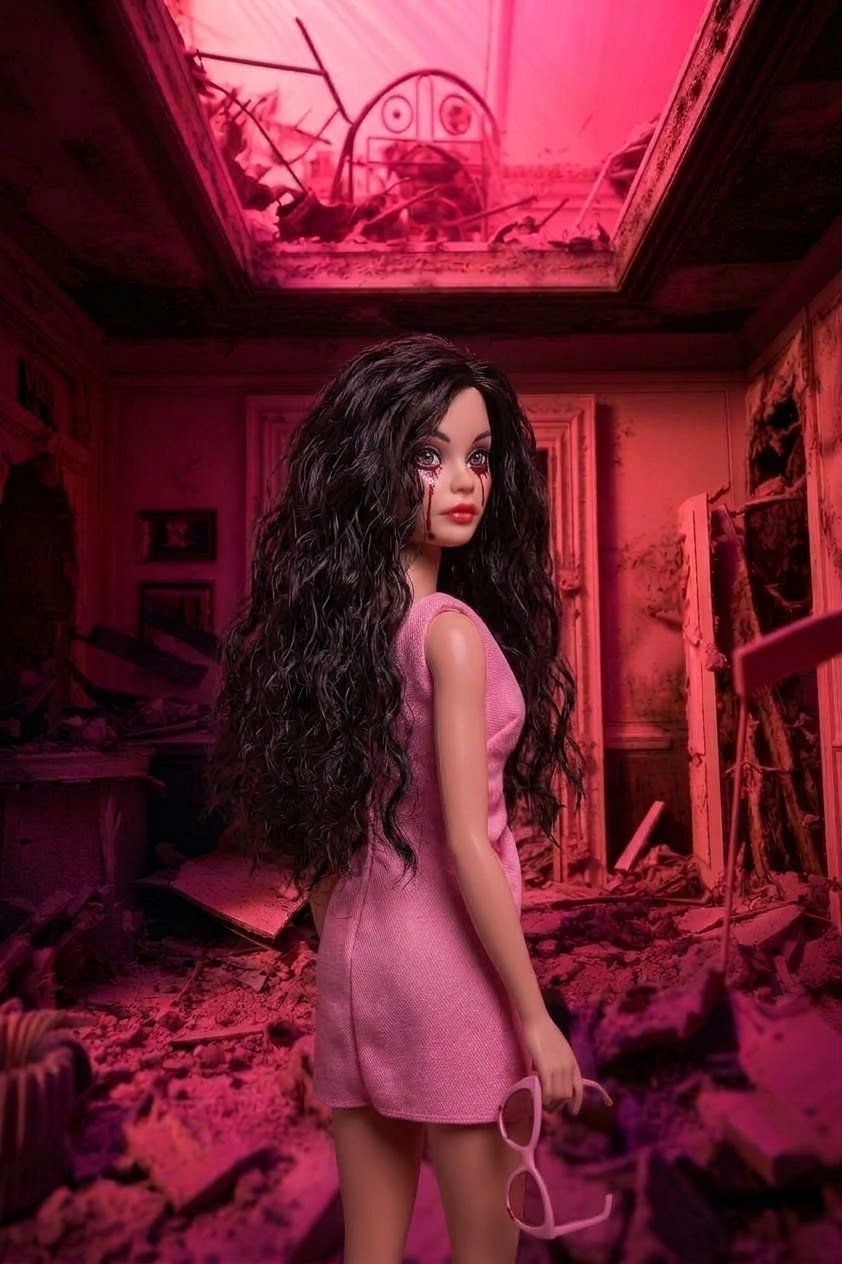
What are you refusing to accept?
